
AlphaFold predicted structure
ACTB · P60709
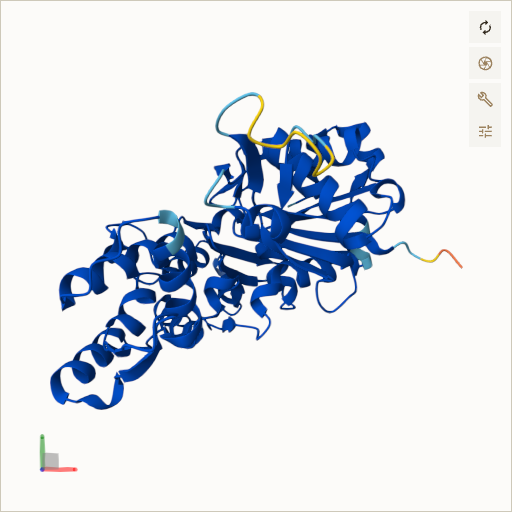

Mean pLDDT
95.2/ 100
Very high
375 residues
Confidence breakdown
- Very high(≥ 90)93%
- Confident(70–90)5%
- Low(50–70)2%
- Very low(< 50)1%
Open interactive 3D viewer
AlphaFold (Jumper et al., 2021) · CC BY 4.0
actin beta
Annotations refreshed 2 months ago.
Diagnostic Grade (Green)
Adult onset dystonia, chorea or related movement disorder
MONOALLELIC, autosomal or pseudoautosomal, imprinted status unknownBleeding and platelet disorders
BOTH monoallelic and biallelic, autosomal or pseudoautosomalChildhood onset dystonia, chorea or related movement disorder
MONOALLELIC, autosomal or pseudoautosomal, imprinted status unknownClefting
MONOALLELIC, autosomal or pseudoautosomal, imprinted status unknownCOVID-19 research
MONOALLELIC, autosomal or pseudoautosomal, imprinted status unknownDDG2P
MONOALLELIC, autosomal or pseudoautosomal, imprinted status unknownEarly onset dystonia
MONOALLELIC, autosomal or pseudoautosomal, imprinted status unknownFetal anomalies
MONOALLELIC, autosomal or pseudoautosomal, NOT imprinted+11 more panels — install the extension to see the full list inline on any page.
Baraitser-Winter syndrome 1
developmental malformations-deafness-dystonia syndrome
Baraitser-Winter syndrome
Developmental malformations - deafness - dystonia
ACTB-associated syndromic thrombocytopenia
Baraitser-Winter cerebrofrontofacial syndrome
cancer
Becker nevus syndrome
Short stature - intellectual disability - eye anomalies - cleft lip/palate
hereditary disease
Score is the Open Targets composite evidence score (0-1). Higher = stronger gene-disease association.
Actin, cytoplasmic 1
Actin is a highly conserved protein that polymerizes to produce filaments that form cross-linked networks in the cytoplasm of cells (PubMed:25255767, PubMed:29581253). Actin exists in both monomeric (G-actin) and polymeric (F-actin) forms, both forms playing key functions, such as cell motility and contraction (PubMed:29581253). In addition to their role in the cytoplasmic cytoskeleton, G- and F-actin also localize in the nucleus, and regulate gene transcription and motility and repair of damaged DNA (PubMed:29925947). Plays a role in the assembly of the gamma-tubulin ring complex (gTuRC), which regulates the minus-end nucleation of alpha-beta tubulin heterodimers that grow into microtubule protafilaments (PubMed:39321809, PubMed:38609661). Part of the ACTR1A/ACTB filament around which the dynactin complex is built (By similarity). The dynactin multiprotein complex activates the molecular motor dynein for ultra-processive transport along microtubules (By similarity)
ACTB · P60709
Mean pLDDT
95.2/ 100
Very high
375 residues
Confidence breakdown
AlphaFold (Jumper et al., 2021) · CC BY 4.0