
AlphaFold predicted structure
ADAR · P55265
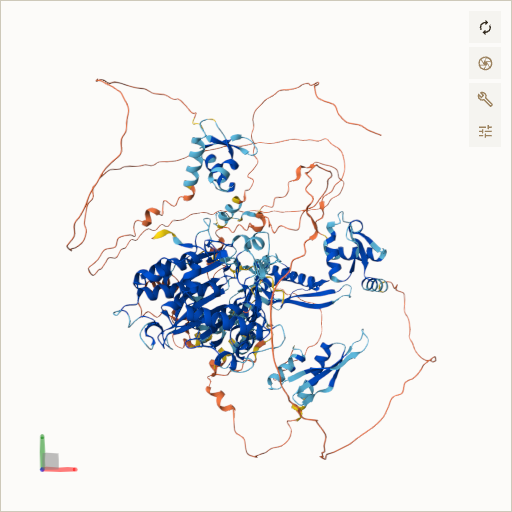

Mean pLDDT
68.4/ 100
Low
1,226 residues
Confidence breakdown
- Very high(≥ 90)34%
- Confident(70–90)25%
- Low(50–70)5%
- Very low(< 50)36%
Open interactive 3D viewer
AlphaFold (Jumper et al., 2021) · CC BY 4.0
adenosine deaminase RNA specific
Annotations refreshed 3 months ago.
Diagnostic Grade (Green)
Adult onset hereditary spastic paraplegia
BIALLELIC, autosomal or pseudoautosomalChildhood onset dystonia, chorea or related movement disorder
BOTH monoallelic and biallelic, autosomal or pseudoautosomalChildhood onset hereditary spastic paraplegia
BIALLELIC, autosomal or pseudoautosomalCOVID-19 research
BIALLELIC, autosomal or pseudoautosomalDDG2P
BOTH monoallelic and biallelic, autosomal or pseudoautosomalEarly onset dystonia
BOTH monoallelic and biallelic, autosomal or pseudoautosomalEarly onset or syndromic epilepsy
BIALLELIC, autosomal or pseudoautosomalFetal anomalies
BOTH monoallelic and biallelic, autosomal or pseudoautosomal+13 more panels — install the extension to see the full list inline on any page.
Aicardi-Goutieres syndrome 6
dyschromatosis symmetrica hereditaria
Aicardi-Goutières syndrome
ADAR-related type 1 interferonopathy
hereditary disease
type 1 interferonopathy
Aicardi-Goutieres syndrome
cholelithiasis
ADAR-related hereditary spastic paraplegia
familial infantile bilateral striatal necrosis
Score is the Open Targets composite evidence score (0-1). Higher = stronger gene-disease association.
Double-stranded RNA-specific adenosine deaminase
Catalyzes the hydrolytic deamination of adenosine to inosine in double-stranded RNA (dsRNA) referred to as A-to-I RNA editing (PubMed:12618436, PubMed:7565688, PubMed:7972084). This may affect gene expression and function in a number of ways that include mRNA translation by changing codons and hence the amino acid sequence of proteins since the translational machinery read the inosine as a guanosine; pre-mRNA splicing by altering splice site recognition sequences; RNA stability by changing sequences involved in nuclease recognition; genetic stability in the case of RNA virus genomes by changing sequences during viral RNA replication; and RNA structure-dependent activities such as microRNA production or targeting or protein-RNA interactions. Can edit both viral and cellular RNAs and can edit RNAs at multiple sites (hyper-editing) or at specific sites (site-specific editing). Its cellular RNA substrates include: bladder cancer-associated protein (BLCAP), neurotransmitter receptors for glutamate (GRIA2) and serotonin (HTR2C) and GABA receptor (GABRA3). Site-specific RNA editing of transcripts encoding these proteins results in amino acid substitutions which consequently alters their functional activities. Exhibits low-level editing at the GRIA2 Q/R site, but edits efficiently at the R/G site and HOTSPOT1. Its viral RNA substrates include: hepatitis C virus (HCV), vesicular stomatitis virus (VSV), measles virus (MV), hepatitis delta virus (HDV), and human immunodeficiency virus type 1 (HIV-1). Exhibits either a proviral (HDV, MV, VSV and HIV-1) or an antiviral effect (HCV) and this can be editing-dependent (HDV and HCV), editing-independent (VSV and MV) or both (HIV-1). Impairs HCV replication via RNA editing at multiple sites. Enhances the replication of MV, VSV and HIV-1 through an editing-independent mechanism via suppression of EIF2AK2/PKR activation and function. Stimulates both the release and infectivity of HIV-1 viral particles by an editing-dependent mechanism where it associates with viral RNAs and edits adenosines in the 5'UTR and the Rev and Tat coding sequence. Can enhance viral replication of HDV via A-to-I editing at a site designated as amber/W, thereby changing an UAG amber stop codon to an UIG tryptophan (W) codon that permits synthesis of the large delta antigen (L-HDAg) which has a key role in the assembly of viral particles. However, high levels of ADAR1 inhibit HDV replication
ADAR · P55265
Mean pLDDT
68.4/ 100
Low
1,226 residues
Confidence breakdown
AlphaFold (Jumper et al., 2021) · CC BY 4.0