
AlphaFold predicted structure
ADAT3 · Q96EY9
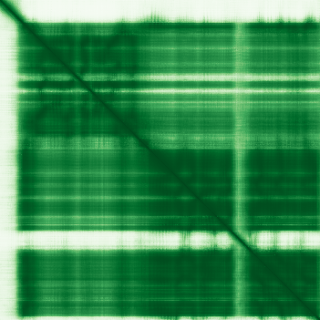
Mean pLDDT
88.3/ 100
Confident
351 residues
Confidence breakdown
- Very high(≥ 90)77%
- Confident(70–90)11%
- Low(50–70)4%
- Very low(< 50)8%
Open interactive 3D viewer
AlphaFold (Jumper et al., 2021) · CC BY 4.0
adenosine deaminase tRNA specific 3
Annotations refreshed 2 months ago.
Diagnostic Grade (Green)
Fetal anomalies
BIALLELIC, autosomal or pseudoautosomalIntellectual disability
BIALLELIC, autosomal or pseudoautosomalEarly onset or syndromic epilepsy
BIALLELIC, autosomal or pseudoautosomalintellectual disability-strabismus syndrome
neurodegenerative disease
hereditary disease
microcephaly
neurodevelopmental disorder
cancer
Intellectual disability
cervical carcinoma
Neurodevelopmental delay
Strabismus
Score is the Open Targets composite evidence score (0-1). Higher = stronger gene-disease association.
tRNA-specific adenosine-34 deaminase regulatory subunit ADAT3
Non-catalytic subunit of the tRNA-specific adenosine-34 deaminase complex, composed of the ADAT2 catalytic subunit and the ADAT3 regulatory subunit, which deaminates adenosine-34 (the first, also called wobble position of the anticodon) to inosine in many tRNAs. Inosine-34 allows the decoding of 3 different nucleotides at the third position of mRNA codons, as inosine is able to pair with U, C, and A. Required for binding of the ADAT2-ADAT3 complex to tRNA through its N-terminus, which rotates with respect to the catalytic domain of the complex, formed by ADAT2 and the ADAT3 C-terminal domain, to position the tRNA anticodon stem-loop correctly in the ADAT2 active site. The ADAT2-ADAT3 complex is required for radial migration of projection neurons in the developing brain cortex, and the catalytic activity of the complex is necessary for this function
ADAT3 · Q96EY9
Mean pLDDT
88.3/ 100
Confident
351 residues
Confidence breakdown
AlphaFold (Jumper et al., 2021) · CC BY 4.0