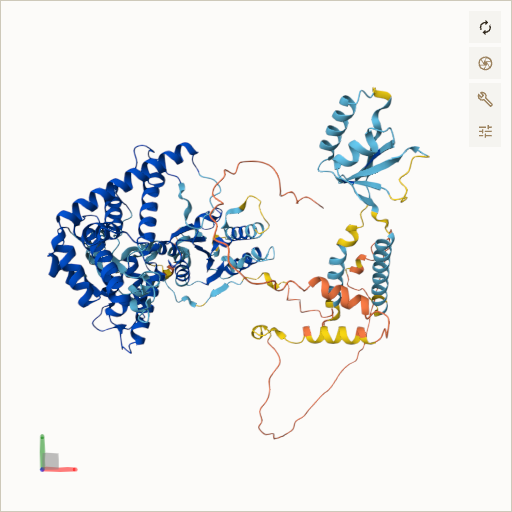
Mitochondrial inner membrane m-AAA protease component AFG3L2
Catalytic component of the m-AAA protease, a protease that plays a key role in proteostasis of inner mitochondrial membrane proteins, and which is essential for axonal and neuron development (PubMed:19748354, PubMed:28396416, PubMed:29932645, PubMed:30683687, PubMed:31327635, PubMed:37917749, PubMed:38157846, PubMed:41075794). AFG3L2 possesses both ATPase and protease activities: the ATPase activity is required to unfold substrates, threading them into the internal proteolytic cavity for hydrolysis into small peptide fragments (PubMed:19748354, PubMed:31327635). The m-AAA protease carries out quality control in the inner membrane of the mitochondria by mediating degradation of mistranslated or misfolded polypeptides (PubMed:26504172, PubMed:30683687, PubMed:34718584). The m-AAA protease complex also promotes the processing and maturation of mitochondrial proteins, such as MRPL32/bL32m, PINK1 and SP7 (PubMed:22354088, PubMed:29932645, PubMed:30252181). Mediates protein maturation of the mitochondrial ribosomal subunit MRPL32/bL32m by catalyzing the cleavage of the presequence of MRPL32/bL32m prior to assembly into the mitochondrial ribosome (PubMed:29932645). Required for SPG7 maturation into its active mature form after SPG7 cleavage by mitochondrial-processing peptidase (MPP) (PubMed:30252181). Required for the maturation of PINK1 into its 52kDa mature form after its cleavage by mitochondrial-processing peptidase (MPP) (PubMed:22354088). Acts as a regulator of calcium in neurons by mediating degradation of SMDT1/EMRE before its assembly with the uniporter complex, limiting the availability of SMDT1/EMRE for MCU assembly and promoting efficient assembly of gatekeeper subunits with MCU (PubMed:27642048, PubMed:28396416). Promotes the proteolytic degradation of GHITM upon hyperpolarization of mitochondria: progressive GHITM degradation leads to respiratory complex I degradation and broad reshaping of the mitochondrial proteome by AFG3L2 (PubMed:35912435). Also acts as a regulator of mitochondrial glutathione homeostasis by mediating cleavage and degradation of SLC25A39 (PubMed:37917749, PubMed:38157846). SLC25A39 cleavage is prevented when SLC25A39 binds iron-sulfur (PubMed:37917749, PubMed:38157846). Also acts as a regulator of carnitine biosynthesis by mediating cleavage and degradation of SLC25A45 (PubMed:41075794). Involved in the regulation of OMA1-dependent processing of OPA1 (PubMed:17615298, PubMed:29545505, PubMed:30252181, PubMed:30683687, PubMed:32600459). May act by mediating processing of OMA1 precursor, participating in OMA1 maturation (PubMed:29545505)