
AlphaFold predicted structure
APTX · Q7Z2E3
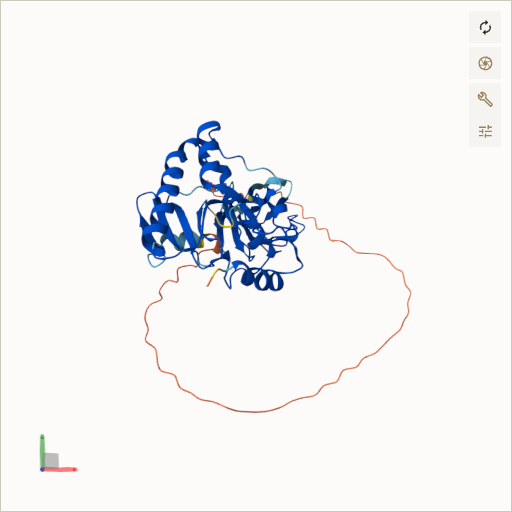

Mean pLDDT
80.8/ 100
Confident
356 residues
Confidence breakdown
- Very high(≥ 90)62%
- Confident(70–90)13%
- Low(50–70)3%
- Very low(< 50)22%
Open interactive 3D viewer
AlphaFold (Jumper et al., 2021) · CC BY 4.0
aprataxin
Annotations refreshed 3 months ago.
Diagnostic Grade (Green)
Adult onset dystonia, chorea or related movement disorder
BIALLELIC, autosomal or pseudoautosomalAtaxia and cerebellar anomalies - narrow panel
BIALLELIC, autosomal or pseudoautosomalChildhood onset dystonia, chorea or related movement disorder
BIALLELIC, autosomal or pseudoautosomalDDG2P
BIALLELIC, autosomal or pseudoautosomalEarly onset dystonia
BIALLELIC, autosomal or pseudoautosomalHereditary ataxia
BIALLELIC, autosomal or pseudoautosomalHereditary ataxia with onset in adulthood
BIALLELIC, autosomal or pseudoautosomalHereditary neuropathy
BIALLELIC, autosomal or pseudoautosomal+8 more panels — install the extension to see the full list inline on any page.
ataxia, early-onset, with oculomotor apraxia and hypoalbuminemia
Ataxia - oculomotor apraxia type 1
hereditary disease
Dystonia
epilepsy
hereditary ataxia
ovarian neoplasm
coenzyme Q10 deficiency, primary, 1
cervical carcinoma
cervical cancer
Score is the Open Targets composite evidence score (0-1). Higher = stronger gene-disease association.
Aprataxin
DNA-binding protein involved in single-strand DNA break repair, double-strand DNA break repair and base excision repair (PubMed:15044383, PubMed:15380105, PubMed:16964241, PubMed:17276982, PubMed:24362567). Resolves abortive DNA ligation intermediates formed either at base excision sites, or when DNA ligases attempt to repair non-ligatable breaks induced by reactive oxygen species (PubMed:16964241, PubMed:24362567). Catalyzes the release of adenylate groups covalently linked to 5'-phosphate termini, resulting in the production of 5'-phosphate termini that can be efficiently rejoined (PubMed:16964241, PubMed:17276982, PubMed:24362567). Also able to hydrolyze adenosine 5'-monophosphoramidate (AMP-NH(2)) and diadenosine tetraphosphate (AppppA), but with lower catalytic activity (PubMed:16547001). Likewise, catalyzes the release of 3'-linked guanosine (DNAppG) and inosine (DNAppI) from DNA, but has higher specific activity with 5'-linked adenosine (AppDNA) (By similarity)
APTX · Q7Z2E3
Mean pLDDT
80.8/ 100
Confident
356 residues
Confidence breakdown
AlphaFold (Jumper et al., 2021) · CC BY 4.0