
AlphaFold predicted structure
ARSA · P15289
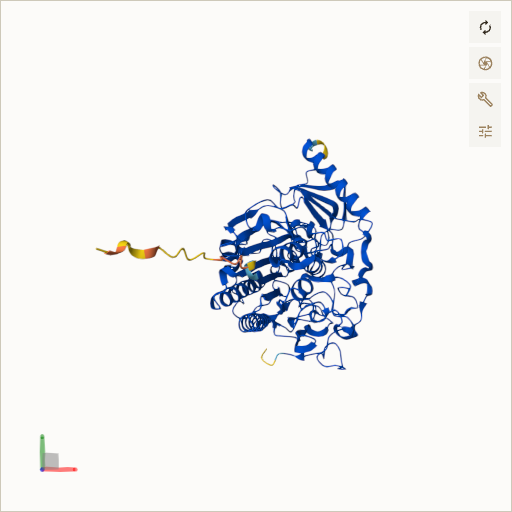

Mean pLDDT
96.1/ 100
Very high
507 residues
Confidence breakdown
- Very high(≥ 90)94%
- Confident(70–90)1%
- Low(50–70)3%
- Very low(< 50)1%
Open interactive 3D viewer
AlphaFold (Jumper et al., 2021) · CC BY 4.0
arylsulfatase A
Annotations refreshed 2 months ago.
Diagnostic Grade (Green)
Adult onset dystonia, chorea or related movement disorder
BIALLELIC, autosomal or pseudoautosomalAdult onset leukodystrophy
BIALLELIC, autosomal or pseudoautosomalAdult onset neurodegenerative disorder
BIALLELIC, autosomal or pseudoautosomalAtaxia and cerebellar anomalies - narrow panel
BIALLELIC, autosomal or pseudoautosomalChildhood onset dystonia, chorea or related movement disorder
BIALLELIC, autosomal or pseudoautosomalDDG2P
BIALLELIC, autosomal or pseudoautosomalFetal anomalies
BIALLELIC, autosomal or pseudoautosomalHereditary ataxia
BIALLELIC, autosomal or pseudoautosomal+12 more panels — install the extension to see the full list inline on any page.
metachromatic leukodystrophy
metachromatic leukodystrophy, juvenile form
metachromatic leukodystrophy, adult form
metachromatic leukodystrophy, late infantile form
hereditary disease
neurodevelopmental disorder
Multiple sulfatase deficiency
Dystonia
leukodystrophy
spastic ataxia
Score is the Open Targets composite evidence score (0-1). Higher = stronger gene-disease association.
ATPase GET3
ATPase required for the post-translational delivery of tail-anchored (TA) proteins to the endoplasmic reticulum (PubMed:17382883). Recognizes and selectively binds the transmembrane domain of TA proteins in the cytosol. This complex then targets to the endoplasmic reticulum by membrane-bound receptors GET1/WRB and CAMLG/GET2, where the tail-anchored protein is released for insertion. This process is regulated by ATP binding and hydrolysis. ATP binding drives the homodimer towards the closed dimer state, facilitating recognition of newly synthesized TA membrane proteins. ATP hydrolysis is required for insertion. Subsequently, the homodimer reverts towards the open dimer state, lowering its affinity for the GET1-CAMLG receptor, and returning it to the cytosol to initiate a new round of targeting. May be involved in insulin signaling
ARSA · P15289
Mean pLDDT
96.1/ 100
Very high
507 residues
Confidence breakdown
AlphaFold (Jumper et al., 2021) · CC BY 4.0