AlphaFold predicted structure
ATP1A3 · P13637
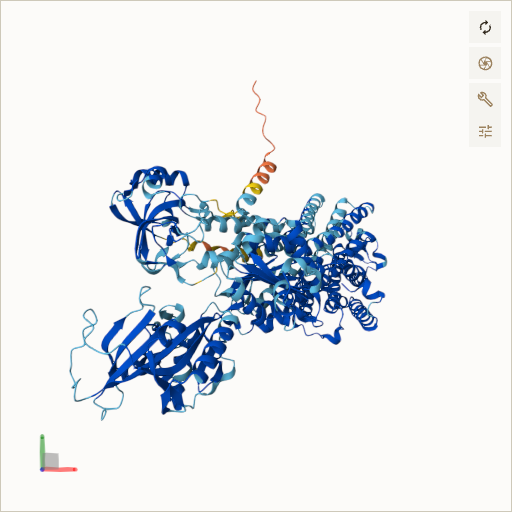

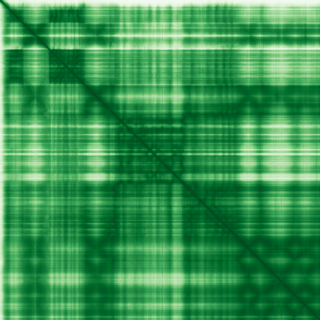
Mean pLDDT
88.8/ 100
Confident
1,013 residues
Confidence breakdown
- Very high(≥ 90)62%
- Confident(70–90)34%
- Low(50–70)3%
- Very low(< 50)2%
AlphaFold (Jumper et al., 2021) · CC BY 4.0
ATPase Na+/K+ transporting subunit alpha 3
Annotations refreshed 1 month ago.
Diagnostic Grade (Green)
Adult onset dystonia, chorea or related movement disorder
MONOALLELIC, autosomal or pseudoautosomal, NOT imprintedAdult onset neurodegenerative disorder
MONOALLELIC, autosomal or pseudoautosomal, imprinted status unknownAtaxia and cerebellar anomalies - narrow panel
MONOALLELIC, autosomal or pseudoautosomal, NOT imprintedAuditory Neuropathy Spectrum Disorde
MONOALLELIC, autosomal or pseudoautosomal, NOT imprintedBrain channelopathy
MONOALLELIC, autosomal or pseudoautosomal, NOT imprintedChildhood onset dystonia, chorea or related movement disorder
MONOALLELIC, autosomal or pseudoautosomal, NOT imprintedDDG2P
MONOALLELIC, autosomal or pseudoautosomal, imprinted status unknownEarly onset dystonia
MONOALLELIC, autosomal or pseudoautosomal, NOT imprinted+8 more panels — install the extension to see the full list inline on any page.
alternating hemiplegia of childhood 2
dystonia 12
Cerebellar ataxia - areflexia - pes cavus - optic atrophy - sensorineural hearing loss
developmental and epileptic encephalopathy 99
cerebellar ataxia-areflexia-pes cavus-optic atrophy-sensorineural hearing loss syndrome
alternating hemiplegia of childhood
Rapid-onset dystonia-parkinsonism
ATP1A3-associated neurological disorder
congestive heart failure
atrial fibrillation
Score is the Open Targets composite evidence score (0-1). Higher = stronger gene-disease association.
Sodium/potassium-transporting ATPase subunit alpha-3
Neuron-specific alpha catalytic component of the Na(+)/K(+)-transporting ATPase, which catalyzes the hydrolysis of ATP coupled with the exchange of Na(+) and K(+) ions across the plasma membrane (PubMed:36075933). Transports 3 Na(+) ions out of the cell and 2 K(+) ions into the cell for each ATP hydrolyze against their electrochemical gradients to maintain ion concentration gradients across the membranes (By similarity). In the brain, ATP1A3 is critical for neuronal cell signaling and for maintenance of electrochemical stability, enabling cell excitation and action potential propagation (PubMed:33880529, PubMed:36075933)
ATP1A3 · P13637


Mean pLDDT
88.8/ 100
Confident
1,013 residues
Confidence breakdown
AlphaFold (Jumper et al., 2021) · CC BY 4.0