X-LINKED: hemizygous mutation in males, biallelic mutations in females
Early onset or syndromic epilepsy
X-LINKED: hemizygous mutation in males, biallelic mutations in females
Ehlers Danlos syndrome with a likely monogenic cause
X-LINKED: hemizygous mutation in males, biallelic mutations in females
Fetal anomalies
X-LINKED: hemizygous mutation in males, biallelic mutations in females
Hereditary neuropathy
X-LINKED: hemizygous mutation in males, biallelic mutations in females
Hereditary neuropathy or pain disorder
X-LINKED: hemizygous mutation in males, biallelic mutations in females
Intellectual disability
X-LINKED: hemizygous mutation in males, biallelic mutations in females
Likely inborn error of metabolism
X-LINKED: hemizygous mutation in males, biallelic mutations in females
+12 more panels — install the extension to see the full list inline on any page.
Disease associations (Open Targets)
Menkes disease
0.86
occipital horn syndrome
0.81
X-linked distal spinal muscular atrophy type 3
0.80
hereditary disease
0.51
distal hereditary motor neuropathy
0.47
Hirschsprung disease
0.37
Ehlers-Danlos syndrome
0.19
Charcot-Marie-Tooth disease
0.15
Charcot-Marie-Tooth disease type 2
0.13
Au-Kline syndrome
0.12
Score is the Open Targets composite evidence score (0-1). Higher = stronger gene-disease association.
Protein function (UniProt)
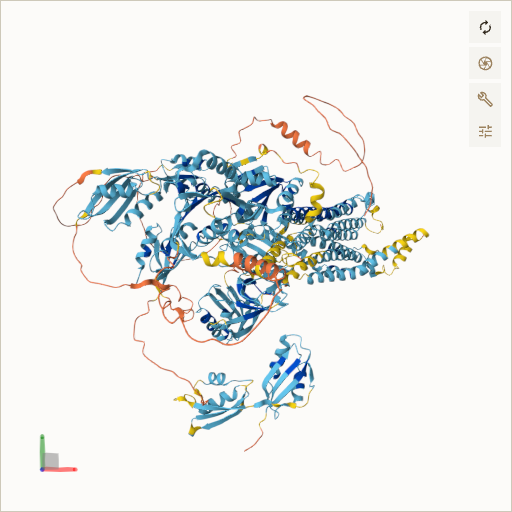
Copper-transporting ATPase 1
ATP-driven copper (Cu(+)) ion pump that plays an important role in intracellular copper ion homeostasis (PubMed:10419525, PubMed:11092760, PubMed:28389643). Within a catalytic cycle, acquires Cu(+) ion from donor protein on the cytoplasmic side of the membrane and delivers it to acceptor protein on the lumenal side. The transfer of Cu(+) ion across the membrane is coupled to ATP hydrolysis and is associated with a transient phosphorylation that shifts the pump conformation from inward-facing to outward-facing state (PubMed:10419525, PubMed:19453293, PubMed:19917612, PubMed:28389643, PubMed:31283225). Under physiological conditions, at low cytosolic copper concentration, it is localized at the trans-Golgi network (TGN) where it transfers Cu(+) ions to cuproenzymes of the secretory pathway (PubMed:11092760, PubMed:28389643). Upon elevated cytosolic copper concentrations, it relocalizes to the plasma membrane where it is responsible for the export of excess Cu(+) ions (PubMed:10419525, PubMed:28389643). May play a dual role in neuron function and survival by regulating cooper efflux and neuronal transmission at the synapse as well as by supplying Cu(+) ions to enzymes such as PAM, TYR and SOD3 (By similarity) (PubMed:28389643). In the melanosomes of pigmented cells, provides copper cofactor to TYR to form an active TYR holoenzyme for melanin biosynthesis (By similarity)