
AlphaFold predicted structure
AUH · Q13825
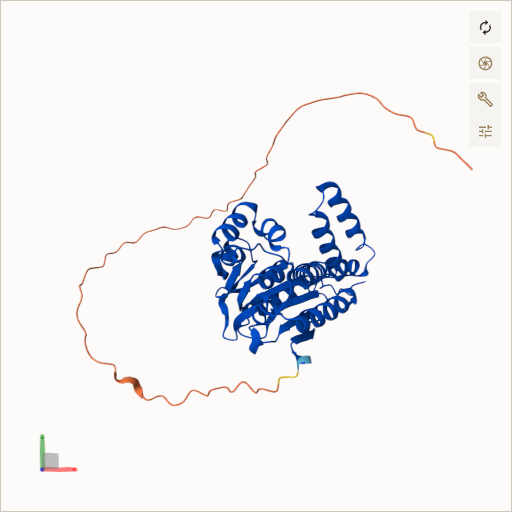

Mean pLDDT
85.7/ 100
Confident
339 residues
Confidence breakdown
- Very high(≥ 90)78%
- Confident(70–90)1%
- Low(50–70)1%
- Very low(< 50)20%
Open interactive 3D viewer
AlphaFold (Jumper et al., 2021) · CC BY 4.0
AU RNA binding methylglutaconyl-CoA hydratase
Annotations refreshed 2 months ago.
Diagnostic Grade (Green)
Adult onset leukodystrophy
BIALLELIC, autosomal or pseudoautosomalAdult onset neurodegenerative disorder
BIALLELIC, autosomal or pseudoautosomalDDG2P
BIALLELIC, autosomal or pseudoautosomalHereditary ataxia with onset in adulthood
BIALLELIC, autosomal or pseudoautosomalHyperammonaemia
BIALLELIC, autosomal or pseudoautosomalIntellectual disability
BIALLELIC, autosomal or pseudoautosomalLikely inborn error of metabolism
BIALLELIC, autosomal or pseudoautosomalUndiagnosed metabolic disorders
BIALLELIC, autosomal or pseudoautosomal+6 more panels — install the extension to see the full list inline on any page.
3-methylglutaconic aciduria type 1
3-methylglutaconic aciduria
Dystonia
Varicose veins
hereditary disease
Alzheimer disease
Parkinson disease
neurodegenerative disease
lysosomal storage disease
multiple sclerosis
Score is the Open Targets composite evidence score (0-1). Higher = stronger gene-disease association.
Methylglutaconyl-CoA hydratase, mitochondrial
Catalyzes the fifth step in the leucine degradation pathway, the reversible hydration of 3-methylglutaconyl-CoA (3-MG-CoA) to 3-hydroxy-3-methylglutaryl-CoA (HMG-CoA) (PubMed:11738050, PubMed:12434311, PubMed:12655555, PubMed:16640564). Can catalyze the reverse reaction but at a much lower rate in vitro (PubMed:16640564). HMG-CoA is then quickly degraded by another enzyme (such as HMG-CoA lyase) to give acetyl-CoA and acetoacetate (PubMed:16640564). Uses other substrates such as (2E)-glutaconyl-CoA efficiently in vitro, and to a lesser extent 3-methylcrotonyl-CoA (3-methyl-(2E)-butenoyl-CoA), crotonyl-CoA ((2E)-butenoyl-CoA) and 3-hydroxybutanoyl-CoA (the missing carboxylate reduces affinity to the active site) (PubMed:16640564). Originally it was identified as an RNA-binding protein as it binds to AU-rich elements (AREs) in vitro (PubMed:7892223). AREs direct rapid RNA degradation and mRNA deadenylation (PubMed:7892223). Might have itaconyl-CoA hydratase activity, converting itaconyl-CoA into citramalyl-CoA in the C5-dicarboxylate catabolism pathway (PubMed:29056341). The C5-dicarboxylate catabolism pathway is required to detoxify itaconate, an antimicrobial metabolite and immunomodulator produced by macrophages during certain infections, that can act as a vitamin B12-poisoning metabolite (PubMed:29056341)
AUH · Q13825
Mean pLDDT
85.7/ 100
Confident
339 residues
Confidence breakdown
AlphaFold (Jumper et al., 2021) · CC BY 4.0