
AlphaFold predicted structure
BBS5 · Q8N3I7
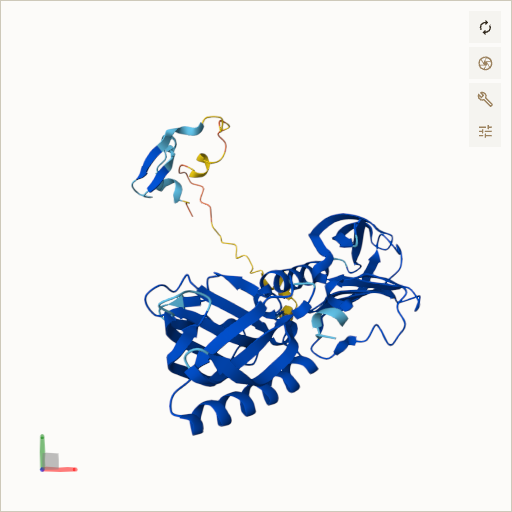
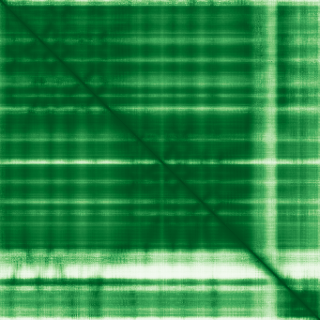
Mean pLDDT
88.7/ 100
Confident
341 residues
Confidence breakdown
- Very high(≥ 90)73%
- Confident(70–90)14%
- Low(50–70)10%
- Very low(< 50)4%
Open interactive 3D viewer
AlphaFold (Jumper et al., 2021) · CC BY 4.0
Bardet-Biedl syndrome 5
Annotations refreshed 2 months ago.
Diagnostic Grade (Green)
Bardet Biedl syndrome
BIALLELIC, autosomal or pseudoautosomalDDG2P
BIALLELIC, autosomal or pseudoautosomalFetal anomalies
BIALLELIC, autosomal or pseudoautosomalIntellectual disability
BIALLELIC, autosomal or pseudoautosomalLimb disorders
BIALLELIC, autosomal or pseudoautosomalOphthalmological ciliopathies
BIALLELIC, autosomal or pseudoautosomalRare multisystem ciliopathy disorders
BIALLELIC, autosomal or pseudoautosomalRenal ciliopathies
BIALLELIC, autosomal or pseudoautosomal+12 more panels — install the extension to see the full list inline on any page.
Bardet-Biedl syndrome 5
Bardet-Biedl syndrome
Bardet-Biedl syndrome 1
polydactyly
Retinal dystrophy
obesity due to melanocortin 4 receptor deficiency
Obesity
obesity disorder
eye disorder
neurodegenerative disease
Score is the Open Targets composite evidence score (0-1). Higher = stronger gene-disease association.
BBSome complex member BBS5
The BBSome complex is thought to function as a coat complex required for sorting of specific membrane proteins to the primary cilia. The BBSome complex is required for ciliogenesis but is dispensable for centriolar satellite function. This ciliogenic function is mediated in part by the Rab8 GDP/GTP exchange factor, which localizes to the basal body and contacts the BBSome. Rab8(GTP) enters the primary cilium and promotes extension of the ciliary membrane. Firstly the BBSome associates with the ciliary membrane and binds to RAB3IP/Rabin8, the guanosyl exchange factor (GEF) for Rab8 and then the Rab8-GTP localizes to the cilium and promotes docking and fusion of carrier vesicles to the base of the ciliary membrane. The BBSome complex, together with the LTZL1, controls SMO ciliary trafficking and contributes to the sonic hedgehog (SHH) pathway regulation. Required for BBSome complex ciliary localization but not for the proper complex assembly
BBS5 · Q8N3I7
Mean pLDDT
88.7/ 100
Confident
341 residues
Confidence breakdown
AlphaFold (Jumper et al., 2021) · CC BY 4.0