
AlphaFold predicted structure
CBL · P22681
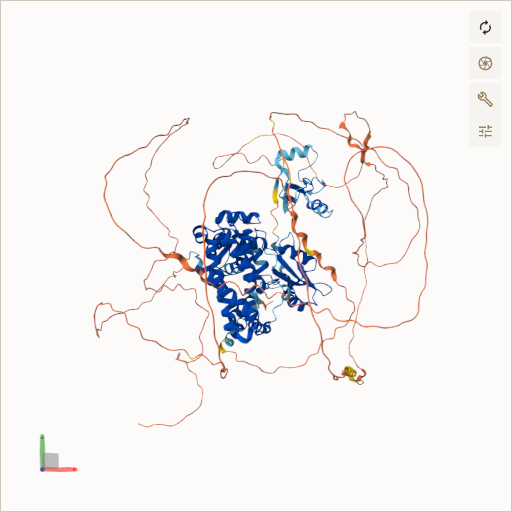
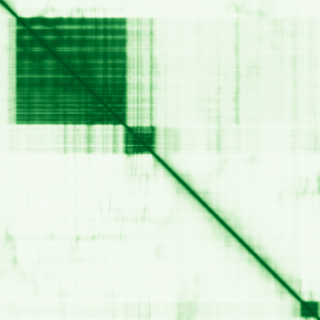
Mean pLDDT
62.8/ 100
Low
906 residues
Confidence breakdown
- Very high(≥ 90)34%
- Confident(70–90)13%
- Low(50–70)3%
- Very low(< 50)51%
Open interactive 3D viewer
AlphaFold (Jumper et al., 2021) · CC BY 4.0
Cbl proto-oncogene
Annotations refreshed 2 months ago.
Diagnostic Grade (Green)
Adult solid tumours cancer susceptibility
MONOALLELIC, autosomal or pseudoautosomal, imprinted status unknownCerebral vascular malformations
MONOALLELIC, autosomal or pseudoautosomal, NOT imprintedChildhood solid tumours
MONOALLELIC, autosomal or pseudoautosomal, imprinted status unknownChildhood solid tumours cancer susceptibility
MONOALLELIC, autosomal or pseudoautosomal, imprinted status unknownDDG2P
MONOALLELIC, autosomal or pseudoautosomal, imprinted status unknownEmbryonal tumour of possible germline origin
MONOALLELIC, autosomal or pseudoautosomal, imprinted status unknownFetal anomalies
MONOALLELIC, autosomal or pseudoautosomal, imprinted status unknownFetal hydrops
MONOALLELIC, autosomal or pseudoautosomal, NOT imprinted+12 more panels — install the extension to see the full list inline on any page.
Noonan syndrome-like disorder with juvenile myelomonocytic leukemia
CBL-related disorder
juvenile myelomonocytic leukemia
Noonan syndrome
RASopathy
listeriosis
cancer
Abnormality of the cardiovascular system
Noonan syndrome and Noonan-related syndrome
hereditary disease
Score is the Open Targets composite evidence score (0-1). Higher = stronger gene-disease association.
E3 ubiquitin-protein ligase CBL
E3 ubiquitin-protein ligase that acts as a negative regulator of many signaling pathways by mediating ubiquitination of cell surface receptors (PubMed:10514377, PubMed:11896602, PubMed:14661060, PubMed:14739300, PubMed:15190072, PubMed:17509076, PubMed:18374639, PubMed:19689429, PubMed:21596750, PubMed:28381567, PubMed:40101708). Accepts ubiquitin from specific E2 ubiquitin-conjugating enzymes, and then transfers it to substrates promoting their degradation by the proteasome (PubMed:10514377, PubMed:14661060, PubMed:14739300, PubMed:17094949, PubMed:17509076, PubMed:17974561). Recognizes activated receptor tyrosine kinases, including KIT, FLT1, FGFR1, FGFR2, PDGFRA, PDGFRB, CSF1R, EPHA8 and KDR and mediates their ubiquitination to terminate signaling (PubMed:15190072, PubMed:18374639, PubMed:21596750). Recognizes membrane-bound HCK, SRC and other kinases of the SRC family and mediates their ubiquitination and degradation (PubMed:11896602). Ubiquitinates EGFR and SPRY2 (PubMed:17094949, PubMed:17974561). Involved in LAG3-mediated inhibition of TCR signaling: following ligand-binding to LAG3, catalyzes 'Lys-63'-linked ubiquitination of LAG3, unleashing the LAG3 C-terminus from the membrane, and initiating a signaling that prevents TCR activation (PubMed:40101708). Ubiquitinates NECTIN1 following association between NECTIN1 and herpes simplex virus 1/HHV-1 envelope glycoprotein D, leading to NECTIN1 removal from cell surface (PubMed:28381567). Participates in signal transduction in hematopoietic cells. Plays an important role in the regulation of osteoblast differentiation and apoptosis (PubMed:15190072, PubMed:18374639). Essential for osteoclastic bone resorption (PubMed:14739300). The 'Tyr-731' phosphorylated form induces the activation and recruitment of phosphatidylinositol 3-kinase to the cell membrane in a signaling pathway that is critical for osteoclast function (PubMed:14739300). In association with CBLB, required for proper feedback inhibition of ciliary platelet-derived growth factor receptor-alpha (PDGFRA) signaling pathway via ubiquitination and internalization of PDGFRA (By similarity)
CBL · P22681
Mean pLDDT
62.8/ 100
Low
906 residues
Confidence breakdown
AlphaFold (Jumper et al., 2021) · CC BY 4.0