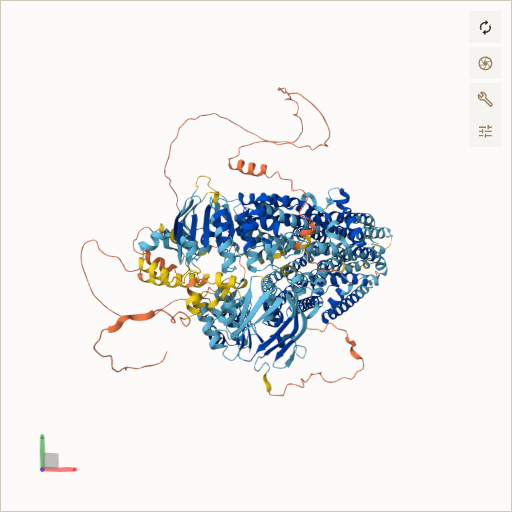
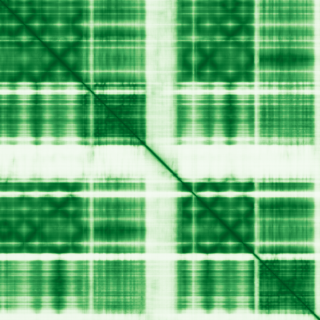
Cystic fibrosis transmembrane conductance regulator
Epithelial ion channel that plays an important role in the regulation of epithelial ion and water transport and fluid homeostasis (PubMed:26823428). Mediates the transport of chloride ions across the cell membrane (PubMed:10792060, PubMed:11524016, PubMed:11707463, PubMed:12519745, PubMed:12529365, PubMed:12588899, PubMed:12727866, PubMed:15010471, PubMed:17036051, PubMed:1712898, PubMed:17182731, PubMed:19398555, PubMed:19621064, PubMed:22178883, PubMed:25330774, PubMed:26846474, PubMed:28087700, PubMed:8910473, PubMed:9804160). Possesses an intrinsic ATPase activity and utilizes ATP to gate its channel; the passive flow of anions through the channel is gated by cycles of ATP binding and hydrolysis by the ATP-binding domains (PubMed:11524016, PubMed:15284228, PubMed:26627831, PubMed:8910473). The ion channel is also permeable to HCO(3)(-); selectivity depends on the extracellular chloride concentration (PubMed:15010471, PubMed:19019741). In vitro, mediates ATP-dependent glutathione flux (PubMed:12727866). Exerts its function also by modulating the activity of other ion channels and transporters (PubMed:12403779, PubMed:22121115, PubMed:22178883, PubMed:27941075). Plays an important role in airway fluid homeostasis (PubMed:16645176, PubMed:19621064, PubMed:26823428). Contributes to the regulation of the pH and the ion content of the airway surface fluid layer and thereby plays an important role in defense against pathogens (PubMed:14668433, PubMed:16645176, PubMed:26823428). Modulates the activity of the epithelial sodium channel (ENaC) complex, in part by regulating the cell surface expression of the ENaC complex (PubMed:17182731, PubMed:17434346, PubMed:27941075). Inhibits the activity of the ENaC channel containing subunits SCNN1A, SCNN1B and SCNN1G (PubMed:17182731). Inhibits the activity of the ENaC channel containing subunits SCNN1D, SCNN1B and SCNN1G, but not of the ENaC channel containing subunits SCNN1A, SCNN1B and SCNN1G (PubMed:17182731, PubMed:27941075). May regulate bicarbonate secretion and salvage in epithelial cells by regulating the transporter SLC4A7 (PubMed:12403779). Can inhibit the chloride channel activity of ANO1 (PubMed:22178883). Plays a role in the chloride and bicarbonate homeostasis during sperm epididymal maturation and capacitation (PubMed:19923167, PubMed:27714810, PubMed:29393851)