
AlphaFold predicted structure
CLCN1 · P35523
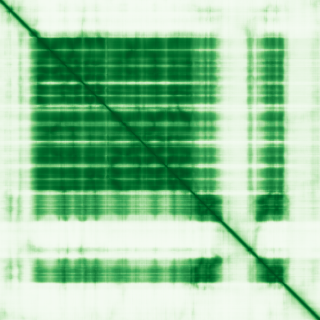
Mean pLDDT
68.4/ 100
Low
988 residues
Confidence breakdown
- Very high(≥ 90)29%
- Confident(70–90)31%
- Low(50–70)8%
- Very low(< 50)32%
Open interactive 3D viewer
AlphaFold (Jumper et al., 2021) · CC BY 4.0
chloride voltage-gated channel 1
Annotations refreshed 2 months ago.
Diagnostic Grade (Green)
Skeletal Muscle Channelopathies
BOTH monoallelic and biallelic, autosomal or pseudoautosomalSkeletal muscle channelopathy
BOTH monoallelic and biallelic, autosomal or pseudoautosomalLimb girdle muscular dystrophies, myofibrillar myopathies and distal myopathies
MONOALLELIC, autosomal or pseudoautosomal, NOT imprintedParoxysmal central nervous system disorders
BOTH monoallelic and biallelic, autosomal or pseudoautosomalmyotonia congenita, autosomal recessive
Thomsen and Becker disease
Myotonia
Tip-toe gait
hyperkalemic periodic paralysis
Abnormality of the musculature
Smith-Lemli-Opitz syndrome
hereditary disease
EMG: myotonic discharges
hypokalemic periodic paralysis, type 1
Score is the Open Targets composite evidence score (0-1). Higher = stronger gene-disease association.
Chloride channel protein 1
Voltage-gated chloride channel involved in skeletal muscle excitability. Generates most of the plasma membrane chloride conductance in skeletal muscle fibers, stabilizes the resting membrane potential and contributes to the repolarization phase during action potential firing (PubMed:12456816, PubMed:16027167, PubMed:22521272, PubMed:22641783, PubMed:26007199, PubMed:26502825, PubMed:26510092, PubMed:7951242, PubMed:8112288, PubMed:8130334, PubMed:9122265, PubMed:9565403, PubMed:9736777). Forms a homodimeric channel where each subunit has its own ion conduction pathway. Conducts double-barreled currents controlled by two types of gates, two fast glutamate gates that control each subunit independently and a slow common gate that opens and shuts off both subunits simultaneously. Has a significant open probability at muscle resting potential and is further activated upon membrane depolarization (PubMed:10051520, PubMed:10962018, PubMed:29809153, PubMed:31022181). Permeable to small monovalent anions with ion selectivity for chloride > thiocyanate > bromide > nitrate > iodide (PubMed:9122265, PubMed:9565403)
CLCN1 · P35523
Mean pLDDT
68.4/ 100
Low
988 residues
Confidence breakdown
AlphaFold (Jumper et al., 2021) · CC BY 4.0