
AlphaFold predicted structure
CNGB1 · Q14028
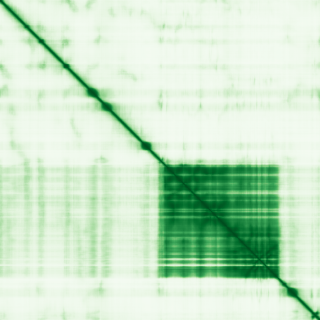
Mean pLDDT
57.7/ 100
Low
1,251 residues
Confidence breakdown
- Very high(≥ 90)17%
- Confident(70–90)23%
- Low(50–70)8%
- Very low(< 50)52%
Open interactive 3D viewer
AlphaFold (Jumper et al., 2021) · CC BY 4.0
cyclic nucleotide gated channel subunit beta 1
Annotations refreshed 2 months ago.
Diagnostic Grade (Green)
Retinal disorders
BIALLELIC, autosomal or pseudoautosomalGlaucoma (developmental)
Structural eye disease
BIALLELIC, autosomal or pseudoautosomalretinitis pigmentosa
retinitis pigmentosa 45
Retinal dystrophy
CNGB1-related retinopathy
autosomal recessive retinitis pigmentosa
Posterior column ataxia - retinitis pigmentosa
eye disorder
disturbance of skin sensation
male reproductive organ cancer
neurodegenerative disease
Score is the Open Targets composite evidence score (0-1). Higher = stronger gene-disease association.
Cyclic nucleotide-gated channel beta-1
Pore-forming subunit of the rod cyclic nucleotide-gated channel. Mediates rod photoresponses at dim light converting transient changes in intracellular cGMP levels into electrical signals. In the dark, cGMP levels are high and keep the channel open enabling a steady inward current carried by Na(+) and Ca(2+) ions that leads to membrane depolarization and neurotransmitter release from synaptic terminals. Upon photon absorption cGMP levels decline leading to channel closure and membrane hyperpolarization that ultimately slows neurotransmitter release and signals the presence of light, the end point of the phototransduction cascade (By similarity) (PubMed:34699778). Pore-forming subunit of the olfactory cyclic nucleotide-gated channel. Operates in the cilia of olfactory sensory neurons where chemical stimulation of the odorant is converted to an electrical signal. Mediates odorant-induced cAMP-dependent Ca(2+) influx triggering neuron depolarization. The rise of intracellular Ca(2+) levels potentiates the olfactory response by activating Ca(2+)-dependent Cl(-) channels, but it also serves as a negative feedback signal to desensitize the channel for rapid adaptation to odorants (By similarity). Conducts cGMP- and cAMP-gated ion currents, with permeability for monovalent and divalent cations. The selectivity for Ca(2+) over Na(+) increases with cGMP concentrations, whereas the selectivity among monovalent ions is independent of the cGMP levels (By similarity) (PubMed:34699778)
CNGB1 · Q14028
Mean pLDDT
57.7/ 100
Low
1,251 residues
Confidence breakdown
AlphaFold (Jumper et al., 2021) · CC BY 4.0