
AlphaFold predicted structure
CNGB3 · Q9NQW8
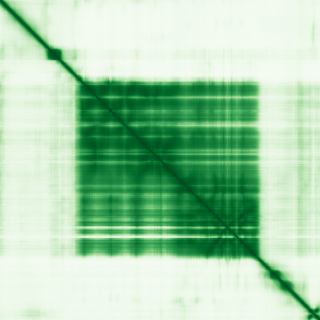
Mean pLDDT
68.1/ 100
Low
809 residues
Confidence breakdown
- Very high(≥ 90)33%
- Confident(70–90)25%
- Low(50–70)6%
- Very low(< 50)36%
Open interactive 3D viewer
AlphaFold (Jumper et al., 2021) · CC BY 4.0
cyclic nucleotide gated channel subunit beta 3
Annotations refreshed 2 months ago.
Diagnostic Grade (Green)
Albinism or congenital nystagmus
BIALLELIC, autosomal or pseudoautosomalRetinal disorders
BIALLELIC, autosomal or pseudoautosomalGlaucoma (developmental)
Structural eye disease
BIALLELIC, autosomal or pseudoautosomalachromatopsia
achromatopsia 3
severe early-childhood-onset retinal dystrophy
Retinal dystrophy
CNGB3-related retinopathy
Leber congenital amaurosis
hereditary disease
Abnormality of the eye
retinal disorder
color vision disorder
Score is the Open Targets composite evidence score (0-1). Higher = stronger gene-disease association.
Cyclic nucleotide-gated channel beta-3
Pore-forming subunit of the cone cyclic nucleotide-gated channel. Mediates cone photoresponses at bright light converting transient changes in intracellular cGMP levels into electrical signals. In the dark, cGMP levels are high and keep the channel open enabling a steady inward current carried by Na(+) and Ca(2+) ions that leads to membrane depolarization and neurotransmitter release from synaptic terminals. Upon photon absorption cGMP levels decline leading to channel closure and membrane hyperpolarization that ultimately slows neurotransmitter release and signals the presence of light, the end point of the phototransduction cascade. Conducts cGMP- and cAMP-gated ion currents, with permeability for monovalent and divalent cations
Curated MONDO disease pages that list CNGB3 among their top associated genes.
CNGB3 · Q9NQW8
Mean pLDDT
68.1/ 100
Low
809 residues
Confidence breakdown
AlphaFold (Jumper et al., 2021) · CC BY 4.0