
AlphaFold predicted structure
COL2A1 · P02458
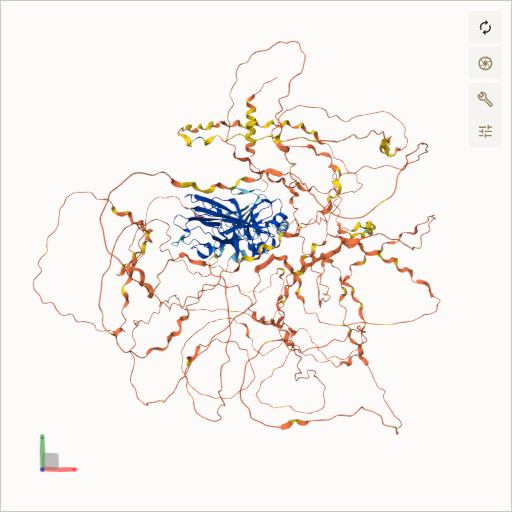

Mean pLDDT
52.1/ 100
Low
1,487 residues
Confidence breakdown
- Very high(≥ 90)13%
- Confident(70–90)6%
- Low(50–70)11%
- Very low(< 50)69%
Open interactive 3D viewer
AlphaFold (Jumper et al., 2021) · CC BY 4.0
collagen type II alpha 1 chain
Annotations refreshed 2 months ago.
Diagnostic Grade (Green)
Bilateral congenital or childhood onset cataracts
MONOALLELIC, autosomal or pseudoautosomal, imprinted status unknownClefting
BOTH monoallelic and biallelic, autosomal or pseudoautosomalDDG2P
MONOALLELIC, autosomal or pseudoautosomal, imprinted status unknownFetal anomalies
MONOALLELIC, autosomal or pseudoautosomal, imprinted status unknownLimb disorders
MONOALLELIC, autosomal or pseudoautosomal, imprinted status unknownMonogenic hearing loss
MONOALLELIC, autosomal or pseudoautosomal, imprinted status unknownRetinal disorders
MONOALLELIC, autosomal or pseudoautosomal, NOT imprintedSkeletal dysplasia
BOTH monoallelic and biallelic, autosomal or pseudoautosomal+11 more panels — install the extension to see the full list inline on any page.
spondyloepiphyseal dysplasia congenita
Stickler syndrome type 1
achondrogenesis type II
Kniest dysplasia
platyspondylic dysplasia, Torrance type
spondyloepimetaphyseal dysplasia, Strudwick type
Achondrogenesis type 2
spondyloperipheral dysplasia
familial avascular necrosis of femoral head
spondyloepiphyseal dysplasia, Stanescu type
Score is the Open Targets composite evidence score (0-1). Higher = stronger gene-disease association.
Collagen alpha-1(II) chain
Type II collagen is specific for cartilaginous tissues. It is essential for the normal embryonic development of the skeleton, for linear growth and for the ability of cartilage to resist compressive forces
Curated MONDO disease pages that list COL2A1 among their top associated genes.
COL2A1 · P02458
Mean pLDDT
52.1/ 100
Low
1,487 residues
Confidence breakdown
AlphaFold (Jumper et al., 2021) · CC BY 4.0