
AlphaFold predicted structure
COQ8A · Q8NI60
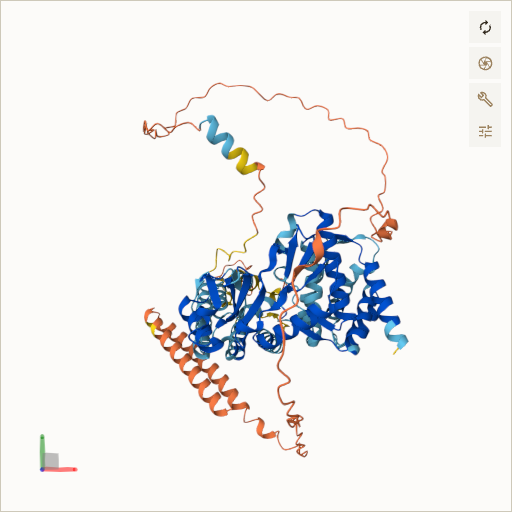

Mean pLDDT
69.6/ 100
Low
647 residues
Confidence breakdown
- Very high(≥ 90)31%
- Confident(70–90)31%
- Low(50–70)8%
- Very low(< 50)30%
Open interactive 3D viewer
AlphaFold (Jumper et al., 2021) · CC BY 4.0
coenzyme Q8A
Annotations refreshed 2 months ago.
Diagnostic Grade (Green)
Acute rhabdomyolysis
BIALLELIC, autosomal or pseudoautosomalAtaxia and cerebellar anomalies - narrow panel
BIALLELIC, autosomal or pseudoautosomalDDG2P
BIALLELIC, autosomal or pseudoautosomalHereditary ataxia
BIALLELIC, autosomal or pseudoautosomalHereditary ataxia with onset in adulthood
BIALLELIC, autosomal or pseudoautosomalInherited white matter disorders
BIALLELIC, autosomal or pseudoautosomalIntellectual disability
BIALLELIC, autosomal or pseudoautosomalLikely inborn error of metabolism
BIALLELIC, autosomal or pseudoautosomal+10 more panels — install the extension to see the full list inline on any page.
autosomal recessive ataxia due to ubiquinone deficiency
coenzyme Q10 deficiency
coenzyme Q10 deficiency, primary, 1
hereditary disease
cataract
Abnormality of the skeletal system
mitochondrial disease
migraine disorder
cerebellar ataxia
mathematical ability
Score is the Open Targets composite evidence score (0-1). Higher = stronger gene-disease association.
Atypical kinase COQ8A, mitochondrial
Atypical kinase involved in the biosynthesis of coenzyme Q, also named ubiquinone, an essential lipid-soluble electron transporter for aerobic cellular respiration (PubMed:21296186, PubMed:25498144, PubMed:25540914, PubMed:27499294, PubMed:36302899, PubMed:38425362). Its substrate specificity is still unclear: may act as a protein kinase that mediates phosphorylation of COQ3 (By similarity). According to other reports, acts as a small molecule kinase, possibly a lipid kinase that phosphorylates a prenyl lipid in the ubiquinone biosynthesis pathway, as suggested by its ability to bind coenzyme Q lipid intermediates (PubMed:25498144, PubMed:27499294). However, the small molecule kinase activity was not confirmed by another publication (By similarity). Shows an unusual selectivity for binding ADP over ATP (PubMed:25498144)
COQ8A · Q8NI60
Mean pLDDT
69.6/ 100
Low
647 residues
Confidence breakdown
AlphaFold (Jumper et al., 2021) · CC BY 4.0