Skip to content
GenoLensGenoLens

CYP27A1

Chr 2q35

cytochrome P450 family 27 subfamily A member 1

Aliases:
CTX, CP27
MANE:
ENST00000258415.9

Annotations refreshed 1 month ago.

Predicted protein structure

Clinical relevance (Genomics England PanelApp)

Diagnostic Grade (Green)

  • Adult onset dystonia, chorea or related movement disorder

    BIALLELIC, autosomal or pseudoautosomal
  • Adult onset hereditary spastic paraplegia

    BIALLELIC, autosomal or pseudoautosomal
  • Adult onset leukodystrophy

    BIALLELIC, autosomal or pseudoautosomal
  • Adult onset neurodegenerative disorder

    BIALLELIC, autosomal or pseudoautosomal
  • Ataxia and cerebellar anomalies - narrow panel

    BIALLELIC, autosomal or pseudoautosomal
  • Bilateral congenital or childhood onset cataracts

    BIALLELIC, autosomal or pseudoautosomal
  • Childhood onset hereditary spastic paraplegia

    BIALLELIC, autosomal or pseudoautosomal
  • Cholestasis

    BIALLELIC, autosomal or pseudoautosomal

+20 more panels — install the extension to see the full list inline on any page.

Disease associations (Open Targets)

  • cerebrotendinous xanthomatosis

    0.87
  • Abnormality of the cardiovascular system

    0.54
  • Senior-Loken syndrome 1

    0.34
  • photosensitive epilepsy

    0.18
  • Seizure

    0.18
  • placental retention

    0.18
  • Intellectual disability

    0.15
  • Abnormality of the skeletal system

    0.12
  • Premature coronary artery atherosclerosis

    0.12
  • breast cancer

    0.10

Score is the Open Targets composite evidence score (0-1). Higher = stronger gene-disease association.

Protein function (UniProt)

Sterol 26-hydroxylase, mitochondrial

Cytochrome P450 monooxygenase that catalyzes regio- and stereospecific hydroxylation of cholesterol and its derivatives. Hydroxylates (with R stereochemistry) the terminal methyl group of cholesterol side-chain in a three step reaction to yield at first a C26 alcohol, then a C26 aldehyde and finally a C26 acid (PubMed:12077124, PubMed:21411718, PubMed:28190002, PubMed:9660774). Regulates cholesterol homeostasis by catalyzing the conversion of excess cholesterol to bile acids via both the 'neutral' (classic) and the 'acid' (alternative) pathways (PubMed:11412116, PubMed:1708392, PubMed:2019602, PubMed:7915755, PubMed:9186905, PubMed:9660774, PubMed:9790667). May also regulate cholesterol homeostasis via generation of active oxysterols, which act as ligands for NR1H2 and NR1H3 nuclear receptors, modulating the transcription of genes involved in lipid metabolism (PubMed:12077124, PubMed:9660774). Catalyzes the conversion of 7-ketocholesterol (7-oxocholesterol) into 7-keto,27-hydroxycholesterol, a precursor of 7-keto,27-hydroxycholesterol, an active oxysterol that activates smoothened (SMO) and the smoothened signaling pathway (By similarity). Plays a role in cholestanol metabolism in the cerebellum. Similarly to cholesterol, hydroxylates cholestanol and may facilitate sterol diffusion through the blood-brain barrier to the systemic circulation for further degradation (PubMed:28190002). Also hydroxylates retinal 7-ketocholesterol, a noxious oxysterol with pro-inflammatory and pro-apoptotic effects, and may play a role in its elimination from the retinal pigment epithelium (PubMed:21411718). May play a redundant role in vitamin D biosynthesis. Catalyzes 25-hydroxylation of vitamin D3 that is required for its conversion to a functionally active form (PubMed:15465040)

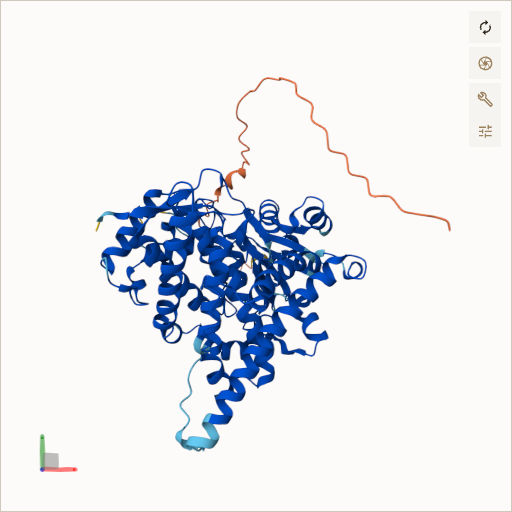
Data sources: HGNC (CC BY 4.0), AlphaFold (CC BY 4.0, Jumper et al. Nature 2021), Genomics England PanelApp (CC BY 4.0), ClinGen, Open Targets (CC0), UniProt.

Not for sole clinical decision-making. Always verify against primary sources.