
AlphaFold predicted structure
DHH · O43323
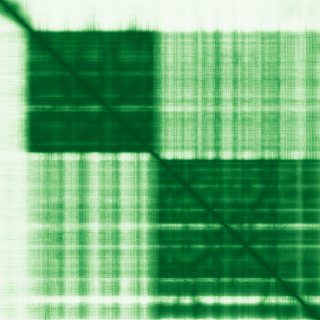
Mean pLDDT
84.4/ 100
Confident
396 residues
Confidence breakdown
- Very high(≥ 90)52%
- Confident(70–90)30%
- Low(50–70)13%
- Very low(< 50)5%
Open interactive 3D viewer
AlphaFold (Jumper et al., 2021) · CC BY 4.0
desert hedgehog signaling molecule
Annotations refreshed 2 months ago.
Diagnostic Grade (Green)
Differences in sex development
BIALLELIC, autosomal or pseudoautosomalHereditary neuropathy or pain disorder
BIALLELIC, autosomal or pseudoautosomalFetal anomalies
BIALLELIC, autosomal or pseudoautosomalHereditary neuropathy
46,XY gonadal dysgenesis-motor and sensory neuropathy syndrome
46,XY complete gonadal dysgenesis
46,XY gonadal dysgenesis - motor and sensory neuropathy
hereditary disease
oral cavity neoplasm
neurodegenerative disease
disorder of sexual differentiation
Genetic 46,XY disorder of sex development
spermatogenic failure
partial chromosome Y deletion
Score is the Open Targets composite evidence score (0-1). Higher = stronger gene-disease association.
Desert hedgehog protein
Precursor of desert hedgehog, a morphogen that activates the smoothened signaling pathway, and which is essential for a variety of patterning events during development (By similarity). The C-terminal part of the precursor displays an autoproteolysis and a cholesterol transferase activity, resulting (1) in the cleavage of the full-length protein into two parts, desert hedgehog protein N-product and C-product and (2) covalent attachment of a cholesterol moiety to the C-terminus of the newly generated N-product (DHH-N) (By similarity). Both autoproteolysis and a cholesterol transferase activities occur in the endoplasmic reticulum (By similarity). Following additional lipidation, DHH-N acts as a morphogen, while the C-product is degraded in the endoplasmic reticulum (By similarity)
DHH · O43323
Mean pLDDT
84.4/ 100
Confident
396 residues
Confidence breakdown
AlphaFold (Jumper et al., 2021) · CC BY 4.0