
AlphaFold predicted structure
ENPP1 · P22413
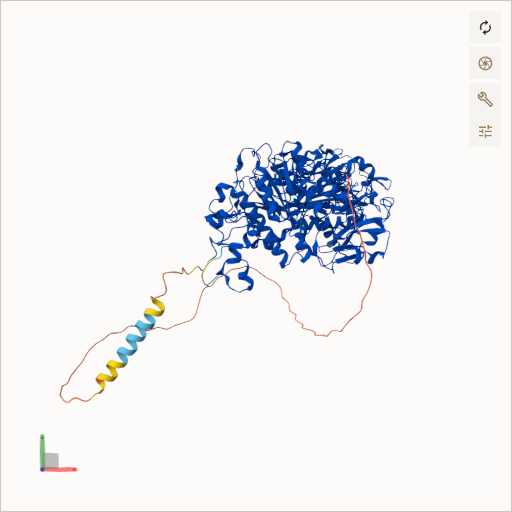
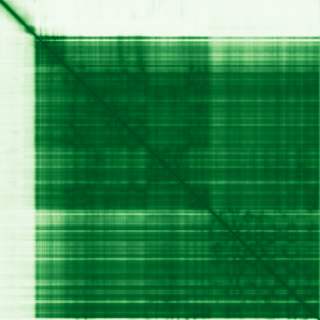
Mean pLDDT
90.7/ 100
Very high
925 residues
Confidence breakdown
- Very high(≥ 90)85%
- Confident(70–90)4%
- Low(50–70)2%
- Very low(< 50)9%
Open interactive 3D viewer
AlphaFold (Jumper et al., 2021) · CC BY 4.0
ectonucleotide pyrophosphatase/phosphodiesterase 1
Annotations refreshed 2 months ago.
Diagnostic Grade (Green)
DDG2P
BIALLELIC, autosomal or pseudoautosomalFetal anomalies
BIALLELIC, autosomal or pseudoautosomalGeneralised arterial calcification in infancy
BIALLELIC, autosomal or pseudoautosomalHypophosphataemia or rickets
BIALLELIC, autosomal or pseudoautosomalIchthyosis and erythrokeratoderma
MONOALLELIC, autosomal or pseudoautosomal, NOT imprintedPalmoplantar keratoderma and erythrokeratodermas
MONOALLELIC, autosomal or pseudoautosomal, NOT imprintedPalmoplantar keratodermas
MONOALLELIC, autosomal or pseudoautosomal, NOT imprintedPigmentary skin disorders
MONOALLELIC, autosomal or pseudoautosomal, NOT imprinted+8 more panels — install the extension to see the full list inline on any page.
arterial calcification, generalized, of infancy, 1
Generalized arterial calcification of infancy
hypopigmentation-punctate palmoplantar keratoderma syndrome
hypophosphatemic rickets, autosomal recessive, 2
type 2 diabetes mellitus
autosomal recessive hypophosphatemic rickets
ossification of the posterior longitudinal ligament of the spine
inherited obesity
Obesity
arterial calcification of infancy
Score is the Open Targets composite evidence score (0-1). Higher = stronger gene-disease association.
Ectonucleotide pyrophosphatase/phosphodiesterase family member 1
Nucleotide pyrophosphatase that generates diphosphate (PPi) and functions in bone mineralization and soft tissue calcification by regulating pyrophosphate levels (By similarity). PPi inhibits bone mineralization and soft tissue calcification by binding to nascent hydroxyapatite crystals, thereby preventing further growth of these crystals (PubMed:11004006). Preferentially hydrolyzes ATP, but can also hydrolyze other nucleoside 5' triphosphates such as GTP, CTP and UTP to their corresponding monophosphates with release of pyrophosphate, as well as diadenosine polyphosphates, and also 3',5'-cAMP to AMP (PubMed:25344812, PubMed:27467858, PubMed:28011303, PubMed:35147247, PubMed:8001561). May also be involved in the regulation of the availability of nucleotide sugars in the endoplasmic reticulum and Golgi, and the regulation of purinergic signaling (PubMed:27467858, PubMed:8001561). Inhibits ectopic joint calcification and maintains articular chondrocytes by repressing hedgehog signaling; it is however unclear whether hedgehog inhibition is direct or indirect (By similarity). Appears to modulate insulin sensitivity and function (PubMed:10615944). Also involved in melanogenesis (PubMed:28964717). Also able to hydrolyze 2',3'-cGAMP (cyclic GMP-AMP), a second messenger that activates TMEM173/STING and triggers type-I interferon production (PubMed:25344812). 2',3'-cGAMP degradation takes place in the lumen or extracellular space, and not in the cytosol where it is produced; the role of 2',3'-cGAMP hydrolysis is therefore unclear (PubMed:25344812). Not able to hydrolyze the 2',3'-cGAMP linkage isomer 3'-3'-cGAMP (PubMed:25344812)
ENPP1 · P22413
Mean pLDDT
90.7/ 100
Very high
925 residues
Confidence breakdown
AlphaFold (Jumper et al., 2021) · CC BY 4.0