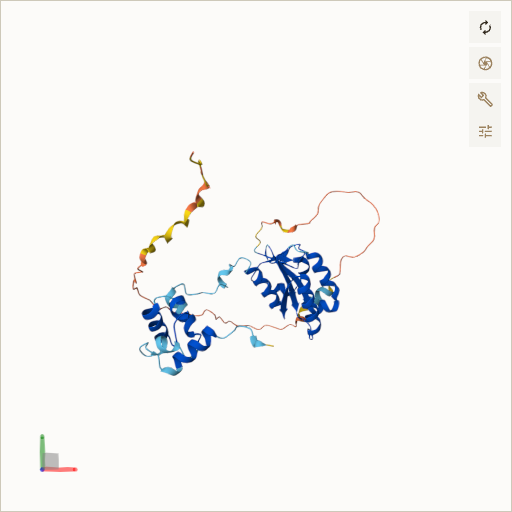
AlphaFold predicted structure
ERCC1 · P07992

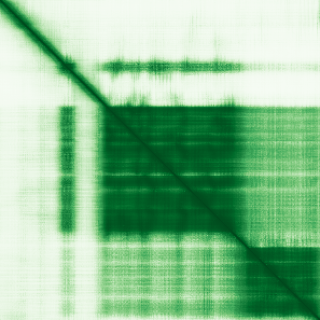
Mean pLDDT
76.3/ 100
Confident
297 residues
Confidence breakdown
- Very high(≥ 90)50%
- Confident(70–90)19%
- Low(50–70)8%
- Very low(< 50)23%
AlphaFold (Jumper et al., 2021) · CC BY 4.0
ERCC excision repair 1, endonuclease non-catalytic subunit
Annotations refreshed 1 month ago.
Diagnostic Grade (Green)
Arthrogryposis
BIALLELIC, autosomal or pseudoautosomalChildhood solid tumours cancer susceptibility
BIALLELIC, autosomal or pseudoautosomalDDG2P
BIALLELIC, autosomal or pseudoautosomalFetal anomalies
BIALLELIC, autosomal or pseudoautosomalIntellectual disability
BIALLELIC, autosomal or pseudoautosomalPaediatric disorders - additional genes
BIALLELIC, autosomal or pseudoautosomalXeroderma pigmentosum, Trichothiodystrophy or Cockayne syndrome
BIALLELIC, autosomal or pseudoautosomalChildhood solid tumours
BIALLELIC, autosomal or pseudoautosomal+7 more panels — install the extension to see the full list inline on any page.
COFS syndrome
Cockayne syndrome
liver disorder
Renal insufficiency
hepatorenal syndrome
xeroderma pigmentosum
Cholestatic liver disease
Failure to thrive
Premature ovarian insufficiency
Global proximal tubulopathy
Score is the Open Targets composite evidence score (0-1). Higher = stronger gene-disease association.
DNA excision repair protein ERCC-1
Non-catalytic component of a structure-specific DNA repair endonuclease responsible for the 5'-incision during DNA repair. Responsible, in conjunction with SLX4, for the first step in the repair of interstrand cross-links (ICL). Participates in the processing of anaphase bridge-generating DNA structures, which consist in incompletely processed DNA lesions arising during S or G2 phase, and can result in cytokinesis failure. Also required for homology-directed repair (HDR) of DNA double-strand breaks, in conjunction with SLX4
Curated MONDO disease pages that list ERCC1 among their top associated genes.
ERCC1 · P07992


Mean pLDDT
76.3/ 100
Confident
297 residues
Confidence breakdown
AlphaFold (Jumper et al., 2021) · CC BY 4.0