
AlphaFold predicted structure
ERCC6 · P0DP91
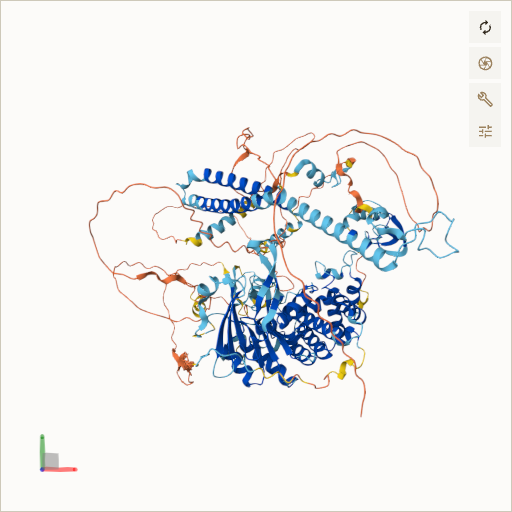
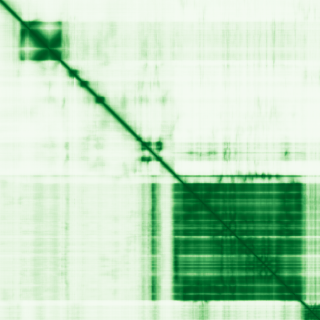
Mean pLDDT
69.3/ 100
Low
1,061 residues
Confidence breakdown
- Very high(≥ 90)32%
- Confident(70–90)29%
- Low(50–70)8%
- Very low(< 50)32%
Open interactive 3D viewer
AlphaFold (Jumper et al., 2021) · CC BY 4.0
ERCC excision repair 6, chromatin remodeling factor
Annotations refreshed 2 months ago.
Diagnostic Grade (Green)
Arthrogryposis
BIALLELIC, autosomal or pseudoautosomalBilateral congenital or childhood onset cataracts
BIALLELIC, autosomal or pseudoautosomalDDG2P
BIALLELIC, autosomal or pseudoautosomalFetal anomalies
BIALLELIC, autosomal or pseudoautosomalHereditary neuropathy
BIALLELIC, autosomal or pseudoautosomalHereditary neuropathy or pain disorder
BIALLELIC, autosomal or pseudoautosomalInherited white matter disorders
BIALLELIC, autosomal or pseudoautosomalIntellectual disability
BIALLELIC, autosomal or pseudoautosomal+15 more panels — install the extension to see the full list inline on any page.
Cockayne syndrome type 2
Cockayne syndrome
cerebrooculofacioskeletal syndrome 1
de Sanctis-Cacchione syndrome
UV-sensitive syndrome 1
premature ovarian failure 11
UV-sensitive syndrome
Cockayne spectrum with or without cerebrooculofacioskeletal syndrome
lung cancer
hereditary disease
Score is the Open Targets composite evidence score (0-1). Higher = stronger gene-disease association.
DNA excision repair protein ERCC-6
Essential factor involved in transcription-coupled nucleotide excision repair (TC-NER), a process during which RNA polymerase II-blocking lesions are rapidly removed from the transcribed strand of active genes (PubMed:16246722, PubMed:20541997, PubMed:22483866, PubMed:26620705, PubMed:32355176, PubMed:34526721, PubMed:38316879, PubMed:38600235, PubMed:38600236). Plays a central role in the initiation of the TC-NER process: specifically recognizes and binds RNA polymerase II stalled at a lesion, and mediates recruitment of ERCC8/CSA, initiating DNA damage excision by TFIIH recruitment (PubMed:32355176, PubMed:34526721, PubMed:38600235, PubMed:38600236). Upon DNA-binding, it locally modifies DNA conformation by wrapping the DNA around itself, thereby modifying the interface between stalled RNA polymerase II and DNA (PubMed:15548521). Acts as a chromatin remodeler at DSBs; DNA-dependent ATPase-dependent activity is essential for this function (PubMed:16246722, PubMed:9565609). Plays an important role in regulating the choice of the DNA double-strand breaks (DSBs) repair pathway and G2/M checkpoint activation; DNA-dependent ATPase activity is essential for this function (PubMed:25820262). Regulates the DNA repair pathway choice by inhibiting non-homologous end joining (NHEJ), thereby promoting the homologous recombination (HR)-mediated repair of DSBs during the S/G2 phases of the cell cycle (PubMed:25820262). Mediates the activation of the ATM- and CHEK2-dependent DNA damage responses thus preventing premature entry of cells into mitosis following the induction of DNA DSBs (PubMed:25820262). Remodels chromatin by evicting histones from chromatin flanking DSBs, limiting RIF1 accumulation at DSBs thereby promoting BRCA1-mediated HR (PubMed:29203878). Required for stable recruitment of ELOA and CUL5 to DNA damage sites (PubMed:28292928). Also involved in UV-induced translocation of ERCC8 to the nuclear matrix (PubMed:26620705). Essential for neuronal differentiation and neuritogenesis; regulates transcription and chromatin remodeling activities required during neurogenesis (PubMed:24874740)
Curated MONDO disease pages that list ERCC6 among their top associated genes.
ERCC6 · P0DP91
Mean pLDDT
69.3/ 100
Low
1,061 residues
Confidence breakdown
AlphaFold (Jumper et al., 2021) · CC BY 4.0