
AlphaFold predicted structure
ERCC8 · Q13216
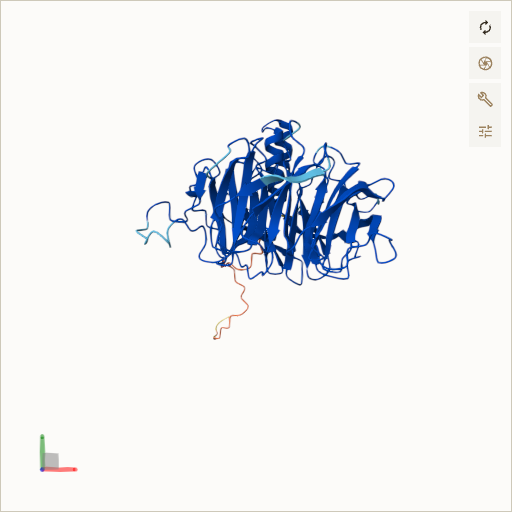
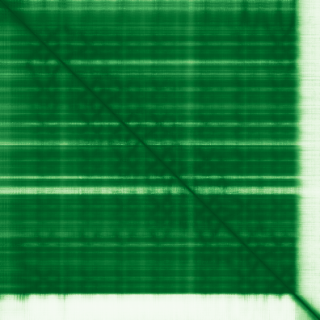
Mean pLDDT
91.6/ 100
Very high
396 residues
Confidence breakdown
- Very high(≥ 90)86%
- Confident(70–90)6%
- Low(50–70)2%
- Very low(< 50)6%
Open interactive 3D viewer
AlphaFold (Jumper et al., 2021) · CC BY 4.0
ERCC excision repair 8, CSA ubiquitin ligase complex subunit
Annotations refreshed 3 months ago.
Diagnostic Grade (Green)
Arthrogryposis
BIALLELIC, autosomal or pseudoautosomalBilateral congenital or childhood onset cataracts
BIALLELIC, autosomal or pseudoautosomalDDG2P
BIALLELIC, autosomal or pseudoautosomalFetal anomalies
BIALLELIC, autosomal or pseudoautosomalHereditary neuropathy
BIALLELIC, autosomal or pseudoautosomalHereditary neuropathy or pain disorder
BIALLELIC, autosomal or pseudoautosomalInherited white matter disorders
BIALLELIC, autosomal or pseudoautosomalIntellectual disability
BIALLELIC, autosomal or pseudoautosomal+10 more panels — install the extension to see the full list inline on any page.
Cockayne syndrome type 1
Cockayne syndrome
UV-sensitive syndrome 2
UV-sensitive syndrome
hereditary disease
Cockayne syndrome type 2
Cockayne syndrome type 3
Parkinson disease
Abnormality of the nervous system
intelligence
Score is the Open Targets composite evidence score (0-1). Higher = stronger gene-disease association.
DNA excision repair protein ERCC-8
Substrate-recognition component of the CSA complex, a DCX (DDB1-CUL4-X-box) E3 ubiquitin-protein ligase complex, involved in transcription-coupled nucleotide excision repair (TC-NER), a process during which RNA polymerase II-blocking lesions are rapidly removed from the transcribed strand of active genes (PubMed:12732143, PubMed:16751180, PubMed:16964240, PubMed:32142649, PubMed:34526721, PubMed:38316879, PubMed:38600235, PubMed:38600236). Following recruitment to lesion-stalled RNA polymerase II (Pol II), the CSA complex mediates ubiquitination of Pol II subunit POLR2A/RPB1 at 'Lys-1268', a critical TC-NER checkpoint, governing RNA Pol II stability and initiating DNA damage excision by TFIIH recruitment (PubMed:12732143, PubMed:16751180, PubMed:16964240, PubMed:32142649, PubMed:32355176, PubMed:34526721, PubMed:38316879, PubMed:38600235, PubMed:38600236). The CSA complex also promotes the ubiquitination and subsequent proteasomal degradation of ERCC6/CSB in a UV-dependent manner; ERCC6 degradation is essential for the recovery of RNA synthesis after transcription-coupled repair (PubMed:16751180). Also plays a role in DNA double-strand breaks (DSSBs) repair by non-homologous end joining (NHEJ) (PubMed:29545921)
ERCC8 · Q13216
Mean pLDDT
91.6/ 100
Very high
396 residues
Confidence breakdown
AlphaFold (Jumper et al., 2021) · CC BY 4.0