
AlphaFold predicted structure
FANCM · Q8IYD8
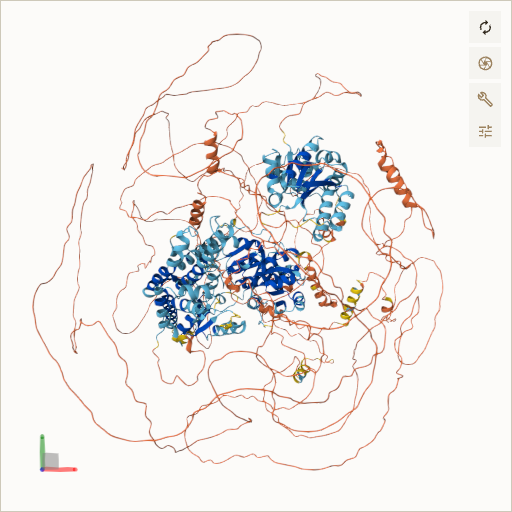
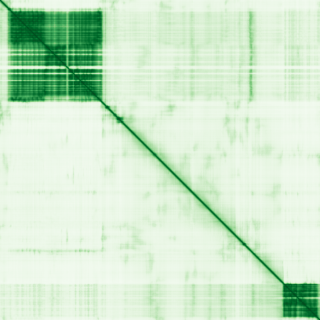
Mean pLDDT
51.7/ 100
Low
2,048 residues
Confidence breakdown
- Very high(≥ 90)13%
- Confident(70–90)23%
- Low(50–70)4%
- Very low(< 50)60%
Open interactive 3D viewer
AlphaFold (Jumper et al., 2021) · CC BY 4.0
FA complementation group M
Annotations refreshed 2 months ago.
Diagnostic Grade (Green)
COVID-19 research
BIALLELIC, autosomal or pseudoautosomalDDG2P
BIALLELIC, autosomal or pseudoautosomalPrimary ovarian insufficiency
BIALLELIC, autosomal or pseudoautosomalChildhood solid tumours cancer susceptibility
BIALLELIC, autosomal or pseudoautosomalFetal anomalies
BIALLELIC, autosomal or pseudoautosomalHaematological malignancies cancer susceptibility
BIALLELIC, autosomal or pseudoautosomalHaematological malignancies for rare disease
BIALLELIC, autosomal or pseudoautosomalHead and neck cancer pertinent cancer susceptibility
BIALLELIC, autosomal or pseudoautosomal+11 more panels — install the extension to see the full list inline on any page.
Fanconi anemia
spermatogenic failure 28
Non-acquired premature ovarian failure
Inherited cancer-predisposing syndrome
hereditary neoplastic syndrome
hereditary breast carcinoma
Hereditary breast cancer
male infertility with azoospermia or oligozoospermia due to single gene mutation
FANCM Fanconi-like genomic instability disorder
Bone marrow hypocellularity
Score is the Open Targets composite evidence score (0-1). Higher = stronger gene-disease association.
Fanconi anemia group M protein
DNA-dependent ATPase component of the Fanconi anemia (FA) core complex (PubMed:16116422). Required for the normal activation of the FA pathway, leading to monoubiquitination of the FANCI-FANCD2 complex in response to DNA damage, cellular resistance to DNA cross-linking drugs, and prevention of chromosomal breakage (PubMed:16116422, PubMed:19423727, PubMed:20347428, PubMed:20347429, PubMed:29231814). In complex with CENPS and CENPX, binds double-stranded DNA (dsDNA), fork-structured DNA (fsDNA) and Holliday junction substrates (PubMed:20347428, PubMed:20347429). Its ATP-dependent DNA branch migration activity can process branched DNA structures such as a movable replication fork. This activity is strongly stimulated in the presence of CENPS and CENPX (PubMed:20347429). In complex with FAAP24, efficiently binds to single-strand DNA (ssDNA), splayed-arm DNA, and 3'-flap substrates (PubMed:17289582). In vitro, on its own, strongly binds ssDNA oligomers and weakly fsDNA, but does not bind to dsDNA (PubMed:16116434)
FANCM · Q8IYD8
Mean pLDDT
51.7/ 100
Low
2,048 residues
Confidence breakdown
AlphaFold (Jumper et al., 2021) · CC BY 4.0