
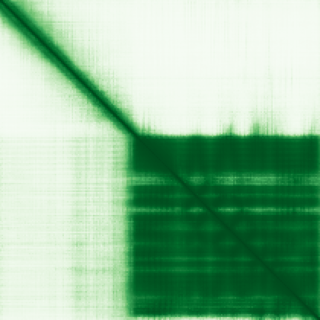
AlphaFold predicted structure
FXN · Q16595
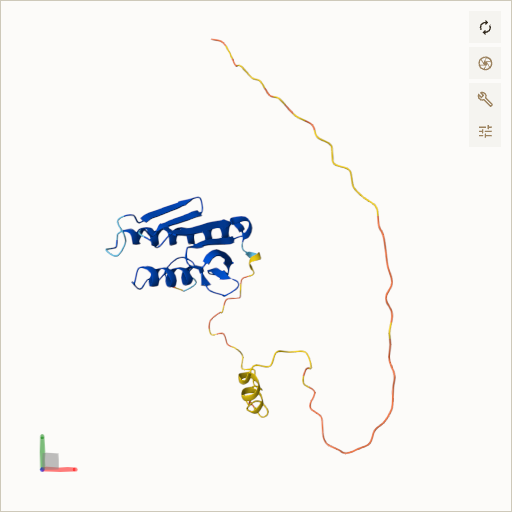
Mean pLDDT
75.5/ 100
Confident
210 residues
Confidence breakdown
- Very high(≥ 90)52%
- Confident(70–90)5%
- Low(50–70)25%
- Very low(< 50)18%
Open interactive 3D viewer
AlphaFold (Jumper et al., 2021) · CC BY 4.0
frataxin
Annotations refreshed 2 months ago.
Diagnostic Grade (Green)
Adult onset hereditary spastic paraplegia
BIALLELIC, autosomal or pseudoautosomalAtaxia and cerebellar anomalies - narrow panel
BIALLELIC, autosomal or pseudoautosomalChildhood onset dystonia, chorea or related movement disorder
BIALLELIC, autosomal or pseudoautosomalChildhood onset hereditary spastic paraplegia
BIALLELIC, autosomal or pseudoautosomalDDG2P
BIALLELIC, autosomal or pseudoautosomalHereditary ataxia
BIALLELIC, autosomal or pseudoautosomalHereditary ataxia with onset in adulthood
BIALLELIC, autosomal or pseudoautosomalHereditary neuropathy
BIALLELIC, autosomal or pseudoautosomal+9 more panels — install the extension to see the full list inline on any page.
Friedreich ataxia
neurodegenerative disease
hereditary disease
Headache
migraine disorder
placental abruption
cellulitis
abscess
nephrotic syndrome
Pain
Score is the Open Targets composite evidence score (0-1). Higher = stronger gene-disease association.
Frataxin, mitochondrial
Functions as an activator of persulfide transfer to the scaffoding protein ISCU as component of the core iron-sulfur cluster (ISC) assembly complex and participates to the [2Fe-2S] cluster assembly (PubMed:12785837, PubMed:24971490). Accelerates sulfur transfer from NFS1 persulfide intermediate to ISCU and to small thiols such as L-cysteine and glutathione leading to persulfuration of these thiols and ultimately sulfide release (PubMed:24971490). Binds ferrous ion and is released from FXN upon the addition of both L-cysteine and reduced FDX2 during [2Fe-2S] cluster assembly (PubMed:29576242). The core iron-sulfur cluster (ISC) assembly complex is involved in the de novo synthesis of a [2Fe-2S] cluster, the first step of the mitochondrial iron-sulfur protein biogenesis. This process is initiated by the cysteine desulfurase complex (NFS1:LYRM4:NDUFAB1) that produces persulfide which is delivered on the scaffold protein ISCU in a FXN-dependent manner. Then this complex is stabilized by FDX2 which provides reducing equivalents to accomplish the [2Fe-2S] cluster assembly. Finally, the [2Fe-2S] cluster is transferred from ISCU to chaperone proteins, including HSCB, HSPA9 and GLRX5 (By similarity). May play a role in the protection against iron-catalyzed oxidative stress through its ability to catalyze the oxidation of Fe(2+) to Fe(3+); the oligomeric form but not the monomeric form has in vitro ferroxidase activity (PubMed:15641778). May be able to store large amounts of iron in the form of a ferrihydrite mineral by oligomerization; however, the physiological relevance is unsure as reports are conflicting and the function has only been shown using heterologous overexpression systems (PubMed:11823441, PubMed:12755598). May function as an iron chaperone protein that protects the aconitase [4Fe-4S]2+ cluster from disassembly and promotes enzyme reactivation (PubMed:15247478). May play a role as a high affinity iron binding partner for FECH that is capable of both delivering iron to ferrochelatase and mediating the terminal step in mitochondrial heme biosynthesis (PubMed:15123683, PubMed:16239244)
FXN · Q16595
Mean pLDDT
75.5/ 100
Confident
210 residues
Confidence breakdown
AlphaFold (Jumper et al., 2021) · CC BY 4.0