
AlphaFold predicted structure
GIGYF2 · Q6Y7W6
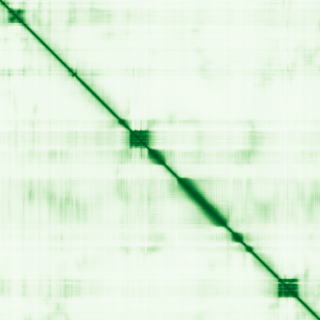
Mean pLDDT
56.4/ 100
Low
1,299 residues
Confidence breakdown
- Very high(≥ 90)5%
- Confident(70–90)30%
- Low(50–70)13%
- Very low(< 50)52%
Open interactive 3D viewer
AlphaFold (Jumper et al., 2021) · CC BY 4.0
GRB10 interacting GYF protein 2
Annotations refreshed 2 months ago.
Moderate Evidence (Amber)
Adult onset neurodegenerative disorder
MONOALLELIC, autosomal or pseudoautosomal, imprinted status unknownAdult onset dystonia, chorea or related movement disorder
Intellectual disability
Parkinson Disease and Complex Parkinsonism
neurodegenerative disease
Leber congenital amaurosis 16
schizophrenia
Parkinson disease
snowflake vitreoretinal degeneration
mathematical ability
Leber congenital amaurosis
Hereditary late-onset Parkinson disease
esophageal disorder
coronary artery disorder
Score is the Open Targets composite evidence score (0-1). Higher = stronger gene-disease association.
GRB10-interacting GYF protein 2
Key component of the 4EHP-GYF2 complex, a multiprotein complex that acts as a repressor of translation initiation (PubMed:22751931, PubMed:31439631, PubMed:35878012). In the 4EHP-GYF2 complex, acts as a factor that bridges EIF4E2 to ZFP36/TTP, linking translation repression with mRNA decay (PubMed:31439631). Also recruits and bridges the association of the 4EHP complex with the decapping effector protein DDX6, which is required for the ZFP36/TTP-mediated down-regulation of AU-rich mRNA (PubMed:31439631). May act cooperatively with GRB10 to regulate tyrosine kinase receptor signaling, including IGF1 and insulin receptors (PubMed:12771153). In association with EIF4E2, assists ribosome-associated quality control (RQC) by sequestering the mRNA cap, blocking ribosome initiation and decreasing the translational load on problematic messages. Part of a pathway that works in parallel to RQC-mediated degradation of the stalled nascent polypeptide (PubMed:32726578). GIGYF2 and EIF4E2 work downstream and independently of ZNF598, which seems to work as a scaffold that can recruit them to faulty mRNA even if alternative recruitment mechanisms may exist (PubMed:32726578)
GIGYF2 · Q6Y7W6
Mean pLDDT
56.4/ 100
Low
1,299 residues
Confidence breakdown
AlphaFold (Jumper et al., 2021) · CC BY 4.0