
AlphaFold predicted structure
GLA · P06280
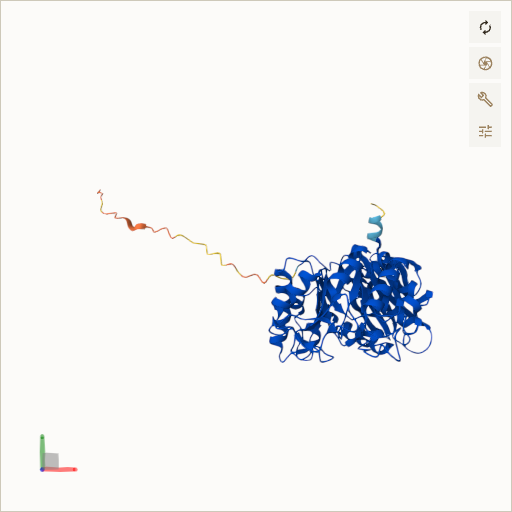
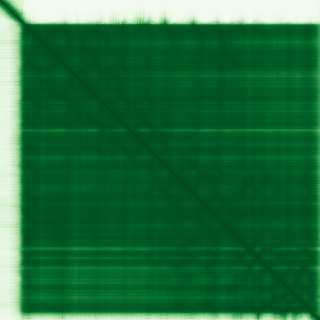
Mean pLDDT
94.3/ 100
Very high
429 residues
Confidence breakdown
- Very high(≥ 90)90%
- Confident(70–90)2%
- Low(50–70)4%
- Very low(< 50)4%
Open interactive 3D viewer
AlphaFold (Jumper et al., 2021) · CC BY 4.0
galactosidase alpha
Annotations refreshed 2 months ago.
Diagnostic Grade (Green)
Adult onset leukodystrophy
X-LINKED: hemizygous mutation in males, monoallelic mutations in females may cause disease (may be less severe, later onset than males)Adult onset neurodegenerative disorder
X-LINKED: hemizygous mutation in males, monoallelic mutations in females may cause disease (may be less severe, later onset than males)Cystic kidney disease
X-LINKED: hemizygous mutation in males, monoallelic mutations in females may cause disease (may be less severe, later onset than males)Fabry disease
X-LINKED: hemizygous mutation in males, monoallelic mutations in females may cause disease (may be less severe, later onset than males)Familial cerebral small vessel disease
X-LINKED: hemizygous mutation in males, monoallelic mutations in females may cause disease (may be less severe, later onset than males)Fetal anomalies
X-LINKED: hemizygous mutation in males, monoallelic mutations in females may cause disease (may be less severe, later onset than males)Fetal hydrops
X-LINKED: hemizygous mutation in males, monoallelic mutations in females may cause disease (may be less severe, later onset than males)Hereditary neuropathy
X-LINKED: hemizygous mutation in males, monoallelic mutations in females may cause disease (may be less severe, later onset than males)+17 more panels — install the extension to see the full list inline on any page.
Fabry disease
cardiomyopathy
Angiokeratoma corporis diffusum
Abnormality of the cardiovascular system
hypertrophic cardiomyopathy
Renal insufficiency
familial hypertrophic cardiomyopathy
stroke disorder
Stroke
kidney failure
Score is the Open Targets composite evidence score (0-1). Higher = stronger gene-disease association.
N-acetyltransferase 8
Endoplasmic reticulum (ER)-membrane-bound lysine N-acetyltransferase catalyzing the N6-acetylation of lysine residues in the lumen of the ER in various proteins, including PROM1 and BACE1, using acetyl-CoA as acetyl donor (PubMed:19011241, PubMed:22267734, PubMed:24556617, PubMed:31945187). Thereby, may regulate apoptosis through the acetylation and the regulation of the expression of PROM1 (PubMed:24556617). May also regulate amyloid beta-peptide secretion through acetylation of BACE1 and the regulation of its expression in neurons (PubMed:19011241). N(6)-lysine acetylation in the ER maintains protein homeostasis and regulates reticulophagy (By similarity). Alternatively, acetylates the free alpha-amino group of cysteine S-conjugates to form mercapturic acids (PubMed:20392701). This is the final step in a major route for detoxification of a wide variety of reactive electrophiles which starts with their incorporation into glutathione S-conjugates. The glutathione S-conjugates are then further processed into cysteine S-conjugates and finally mercapturic acids which are water soluble and can be readily excreted in urine or bile
GLA · P06280
Mean pLDDT
94.3/ 100
Very high
429 residues
Confidence breakdown
AlphaFold (Jumper et al., 2021) · CC BY 4.0