
AlphaFold predicted structure
HADHA · P40939
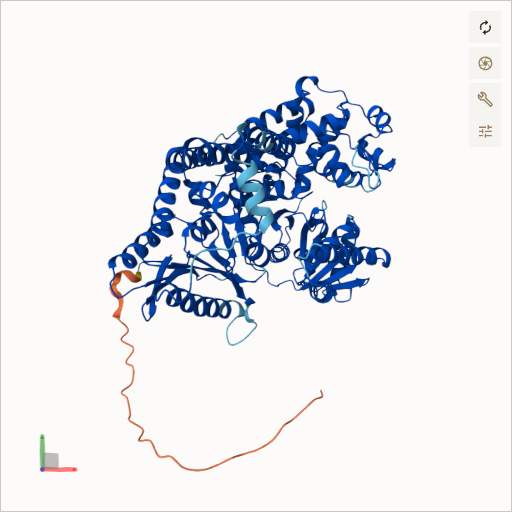
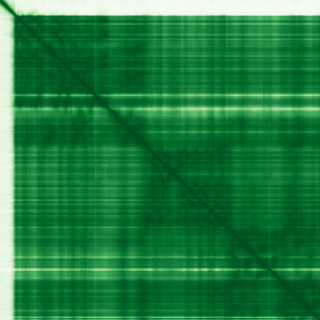
Mean pLDDT
92.4/ 100
Very high
763 residues
Confidence breakdown
- Very high(≥ 90)87%
- Confident(70–90)8%
- Low(50–70)0%
- Very low(< 50)5%
Open interactive 3D viewer
AlphaFold (Jumper et al., 2021) · CC BY 4.0
hydroxyacyl-CoA dehydrogenase trifunctional multienzyme complex subunit alpha
Annotations refreshed 2 months ago.
Diagnostic Grade (Green)
Acute rhabdomyolysis
BIALLELIC, autosomal or pseudoautosomalCholestasis
BIALLELIC, autosomal or pseudoautosomalDDG2P
BIALLELIC, autosomal or pseudoautosomalFetal anomalies
BIALLELIC, autosomal or pseudoautosomalHereditary neuropathy
BIALLELIC, autosomal or pseudoautosomalHereditary neuropathy or pain disorder
BIALLELIC, autosomal or pseudoautosomalHyperammonaemia
BIALLELIC, autosomal or pseudoautosomalIntellectual disability
BIALLELIC, autosomal or pseudoautosomal+10 more panels — install the extension to see the full list inline on any page.
long chain 3-hydroxyacyl-CoA dehydrogenase deficiency
mitochondrial trifunctional protein deficiency
mitochondrial trifunctional protein deficiency 1
hereditary disease
neurodegenerative disease
metabolic disease
cervical carcinoma
Seckel syndrome 6
hepatocellular carcinoma
ovarian cancer
Score is the Open Targets composite evidence score (0-1). Higher = stronger gene-disease association.
Trifunctional enzyme subunit alpha, mitochondrial
Mitochondrial trifunctional enzyme catalyzes the last three of the four reactions of the mitochondrial beta-oxidation pathway (PubMed:1550553, PubMed:29915090, PubMed:30850536, PubMed:8135828, PubMed:31604922). The mitochondrial beta-oxidation pathway is the major energy-producing process in tissues and is performed through cycles of four consecutive reactions (PubMed:29915090). Each beta-oxidation cycle shortens the fatty acyl-CoA by two carbons, yielding one acetyl-CoA (for the citric acid cycle), one FADH(2), and one NADH (which donate electrons to the respiratory chain for ATP production) (PubMed:29915090). These cycles repeat until the chain is fully degraded to acetyl-CoA units (PubMed:29915090). Among the enzymes involved in this pathway, the trifunctional protein--responsible for the hydration, dehydrogenation, and thiolysis steps, shows specificity for long-chain fatty acids, such as those from dietary and stored fats (PubMed:30850536, PubMed:31604922). Mitochondrial trifunctional enzyme is a heterotetrameric complex composed of two proteins, the trifunctional enzyme subunit alpha/HADHA described here carries the 2,3-enoyl-CoA hydratase and the 3-hydroxyacyl-CoA dehydrogenase activities while the trifunctional enzyme subunit beta/HADHB bears the 3-ketoacyl-CoA thiolase activity (Probable) (PubMed:29915090, PubMed:30850536, PubMed:8135828). These activities have been experimentally confirmed on a few substrates derived from beta-oxidation of long-chain saturated fatty acids such as palmitate (hexadecanoate) and laurate (dodecanoate) (PubMed:1550553, PubMed:8135828, PubMed:8163672, PubMed:8651282). In addition, based on its established catalytic mechanism, and combined genetic interaction or mutant phenotype evidence, it is predicted to act also on other substrates, including long-chain unsaturated fatty acids such as oleate (9Z-octadecenoate), linoleate (9Z,12Z-octadecadienoate), linolenate (9Z,12Z,15Z-octadecatrienoate), and others (Probable) (PubMed:26474213). Independently of subunit beta, HADHA also exhibits a cardiolipin acyltransferase activity that participates in cardiolipin remodeling; cardiolipin is a major mitochondrial membrane phospholipid (PubMed:23152787, PubMed:31604922). HADHA may act downstream of Tafazzin/TAZ, that remodels monolysocardiolipin (MLCL) to a cardiolipin intermediate, and then HADHA may continue to remodel this species into mature tetralinoleoyl-cardiolipin (PubMed:31604922). Has also been proposed to act directly on MLCL; capable of acylating MLCL using different acyl-CoA substrates, with highest activity for oleoyl-CoA (PubMed:23152787)
HADHA · P40939
Mean pLDDT
92.4/ 100
Very high
763 residues
Confidence breakdown
AlphaFold (Jumper et al., 2021) · CC BY 4.0