AlphaFold predicted structure
HOMER2 · Q9NSB8
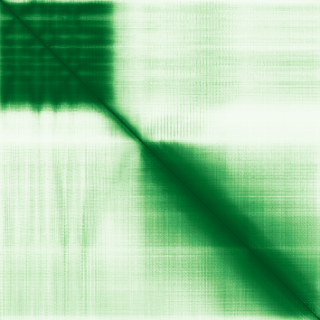
Mean pLDDT
88.4/ 100
Confident
354 residues
Confidence breakdown
- Very high(≥ 90)78%
- Confident(70–90)9%
- Low(50–70)4%
- Very low(< 50)10%
AlphaFold (Jumper et al., 2021) · CC BY 4.0
homer scaffold protein 2
Annotations refreshed 9 hours ago.
Moderate Evidence (Amber)
Monogenic hearing loss
MONOALLELIC, autosomal or pseudoautosomal, paternally imprinted (maternal allele expressed)autosomal dominant nonsyndromic hearing loss
deafness
sarcoidosis
ovarian dysfunction
preeclampsia
Non-syndromic genetic deafness
hereditary disease
nonsyndromic genetic hearing loss
biliary tract disorder
bipolar disorder
Score is the Open Targets composite evidence score (0-1). Higher = stronger gene-disease association.
Homer protein homolog 2
Postsynaptic density scaffolding protein. Binds and cross-links cytoplasmic regions of GRM1, GRM5, ITPR1, DNM3, RYR1, RYR2, SHANK1 and SHANK3. By physically linking GRM1 and GRM5 with ER-associated ITPR1 receptors, it aids the coupling of surface receptors to intracellular calcium release. May also couple GRM1 to PI3 kinase through its interaction with AGAP2. Isoforms can be differently regulated and may play an important role in maintaining the plasticity at glutamatergic synapses (PubMed:9808459). Required for normal hearing (PubMed:25816005). Negatively regulates T cell activation by inhibiting the calcineurin-NFAT pathway. Acts by competing with calcineurin/PPP3CA for NFAT protein binding, hence preventing NFAT activation by PPP3CA (PubMed:18218901)
HOMER2 · Q9NSB8

Mean pLDDT
88.4/ 100
Confident
354 residues
Confidence breakdown
AlphaFold (Jumper et al., 2021) · CC BY 4.0