AlphaFold predicted structure
IFT122 · Q9HBG6
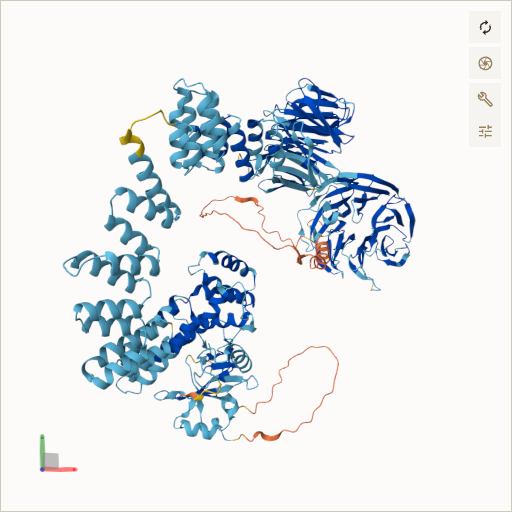

Mean pLDDT
82.9/ 100
Confident
1,241 residues
Confidence breakdown
- Very high(≥ 90)40%
- Confident(70–90)49%
- Low(50–70)3%
- Very low(< 50)8%
AlphaFold (Jumper et al., 2021) · CC BY 4.0
intraflagellar transport 122
Annotations refreshed 1 month ago.
Diagnostic Grade (Green)
DDG2P
BIALLELIC, autosomal or pseudoautosomalFetal anomalies
BIALLELIC, autosomal or pseudoautosomalRare multisystem ciliopathy disorders
BIALLELIC, autosomal or pseudoautosomalRare syndromic craniosynostosis or isolated multisuture synostosis
BIALLELIC, autosomal or pseudoautosomalRenal ciliopathies
BIALLELIC, autosomal or pseudoautosomalSkeletal ciliopathies
BIALLELIC, autosomal or pseudoautosomalSkeletal dysplasia
BIALLELIC, autosomal or pseudoautosomalThoracic dystrophies
BIALLELIC, autosomal or pseudoautosomal+6 more panels — install the extension to see the full list inline on any page.
cranioectodermal dysplasia
glaucoma
Rod-cone dystrophy
Hypercholesterolemia
disease of peritoneum
Parkinson disease
inherited hemoglobinopathy
hereditary disease
connective tissue disorder
Tietze syndrome
Score is the Open Targets composite evidence score (0-1). Higher = stronger gene-disease association.
Intraflagellar transport protein 122 homolog
As a component of the IFT complex A (IFT-A), a complex required for retrograde ciliary transport and entry into cilia of G protein-coupled receptors (GPCRs), it is required in ciliogenesis and ciliary protein trafficking (PubMed:20889716, PubMed:27932497, PubMed:29220510, PubMed:36775821). Involved in cilia formation during neuronal patterning (By similarity)
IFT122 · Q9HBG6


Mean pLDDT
82.9/ 100
Confident
1,241 residues
Confidence breakdown
AlphaFold (Jumper et al., 2021) · CC BY 4.0