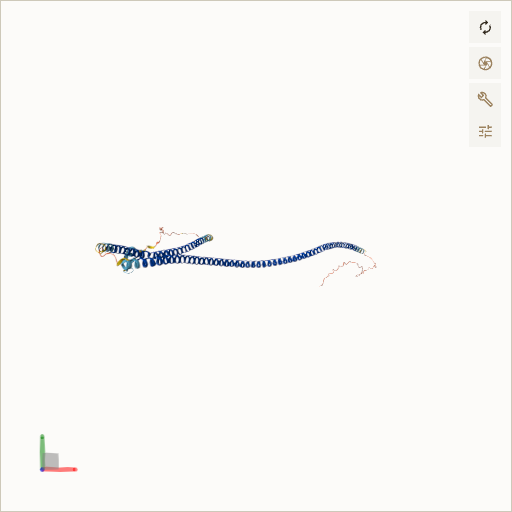
AlphaFold predicted structure
IKBKG · Q9Y6K9


Mean pLDDT
82.0/ 100
Confident
419 residues
Confidence breakdown
- Very high(≥ 90)62%
- Confident(70–90)14%
- Low(50–70)6%
- Very low(< 50)19%
AlphaFold (Jumper et al., 2021) · CC BY 4.0
inhibitor of nuclear factor kappa B kinase regulatory subunit gamma
Annotations refreshed 1 month ago.
Diagnostic Grade (Green)
Autoinflammatory disorders
X-LINKED: hemizygous mutation in males, monoallelic mutations in females may cause disease (may be less severe, later onset than males)COVID-19 research
X-LINKED: hemizygous mutation in males, biallelic mutations in femalesDDG2P
X-LINKED: hemizygous mutation in males, monoallelic mutations in females may cause disease (may be less severe, later onset than males)Early onset or syndromic epilepsy
X-LINKED: hemizygous mutation in males, monoallelic mutations in females may cause disease (may be less severe, later onset than males)Ectodermal dysplasia
X-LINKED: hemizygous mutation in males, biallelic mutations in femalesEctodermal dysplasia without a known gene mutation
X-LINKED: hemizygous mutation in males, biallelic mutations in femalesEpidermolysis bullosa and congenital skin fragility
X-LINKED: hemizygous mutation in males, biallelic mutations in femalesFetal anomalies
X-LINKED: hemizygous mutation in males, monoallelic mutations in females may cause disease (may be less severe, later onset than males)+11 more panels — install the extension to see the full list inline on any page.
incontinentia pigmenti
ectodermal dysplasia and immunodeficiency 1
immunodeficiency 33
Hypohidrotic ectodermal dysplasia with immunodeficiency
autoinflammatory disease, X-linked
hypohidrotic ectodermal dysplasia
Anhidrotic ectodermal dysplasia - immunodeficiency - osteopetrosis - lymphedema
anemia, nonspherocytic hemolytic, due to G6PD deficiency
anhidrotic ectodermal dysplasia-immunodeficiency-osteopetrosis-lymphedema syndrome
hereditary disease
Score is the Open Targets composite evidence score (0-1). Higher = stronger gene-disease association.
NF-kappa-B essential modulator
Regulatory subunit of the IKK core complex which phosphorylates inhibitors of NF-kappa-B thus leading to the dissociation of the inhibitor/NF-kappa-B complex and ultimately the degradation of the inhibitor (PubMed:14695475, PubMed:20724660, PubMed:21518757, PubMed:9751060). Its binding to scaffolding polyubiquitin plays a key role in IKK activation by multiple signaling receptor pathways (PubMed:16547522, PubMed:18287044, PubMed:19033441, PubMed:19185524, PubMed:21606507, PubMed:27777308, PubMed:33567255). Can recognize and bind both 'Lys-63'-linked and linear polyubiquitin upon cell stimulation, with a much higher affinity for linear polyubiquitin (PubMed:16547522, PubMed:18287044, PubMed:19033441, PubMed:19185524, PubMed:21606507, PubMed:27777308). Could be implicated in NF-kappa-B-mediated protection from cytokine toxicity. Essential for viral activation of IRF3 (PubMed:19854139). Involved in TLR3- and IFIH1-mediated antiviral innate response; this function requires 'Lys-27'-linked polyubiquitination (PubMed:20724660)
Curated MONDO disease pages that list IKBKG among their top associated genes.
IKBKG · Q9Y6K9


Mean pLDDT
82.0/ 100
Confident
419 residues
Confidence breakdown
AlphaFold (Jumper et al., 2021) · CC BY 4.0