AlphaFold predicted structure
KCNN2 · Q9H2S1
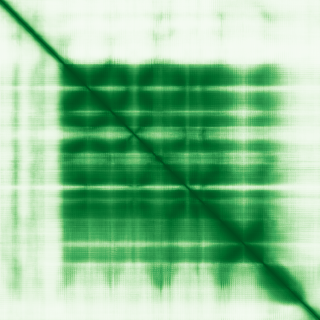
Mean pLDDT
76.5/ 100
Confident
579 residues
Confidence breakdown
- Very high(≥ 90)43%
- Confident(70–90)30%
- Low(50–70)5%
- Very low(< 50)23%
AlphaFold (Jumper et al., 2021) · CC BY 4.0
potassium calcium-activated channel subfamily N member 2
Annotations refreshed 9 hours ago.
Diagnostic Grade (Green)
Ataxia and cerebellar anomalies - narrow panel
MONOALLELIC, autosomal or pseudoautosomal, imprinted status unknownDDG2P
MONOALLELIC, autosomal or pseudoautosomal, imprinted status unknownIntellectual disability
MONOALLELIC, autosomal or pseudoautosomal, NOT imprintedneurodevelopmental disorder with or without variable movement or behavioral abnormalities
Intellectual disability
Seizure
myoclonus-dystonia syndrome
Global developmental delay
atrial fibrillation
Autistic behavior
hereditary disease
movement disorder
Mild intellectual disability
Score is the Open Targets composite evidence score (0-1). Higher = stronger gene-disease association.
Small conductance calcium-activated potassium channel protein 2
Small conductance calcium-activated potassium channel that mediates the voltage-independent transmembrane transfer of potassium across the cell membrane through a constitutive interaction with calmodulin which binds the intracellular calcium allowing its opening (PubMed:10991935, PubMed:33242881, PubMed:9287325). The current is characterized by a voltage-independent activation, an intracellular calcium concentration increase-dependent activation and a single-channel conductance of about 3 picosiemens (PubMed:10991935). Also presents an inwardly rectifying current, thus reducing its already small outward conductance of potassium ions, which is particularly the case when the membrane potential displays positive values, above + 20 mV (PubMed:10991935). The inward rectification could be due to a blockade of the outward current by intracellular divalent cations such as calcium and magnesium and could also be due to an intrinsic property of the channel pore, independent of intracellular divalent ions. There are three positively charged amino acids in the S6 transmembrane domain, close to the pore, that collectively control the conductance and rectification through an electrostatic mechanism. Additionally, electrostatic contributions from these residues also play an important role in determining the intrinsic open probability of the channel in the absence of calcium, affecting the apparent calcium affinity for activation. Forms an heteromeric complex with calmodulin, which is constitutively associated in a calcium-independent manner. Channel opening is triggered when calcium binds the calmodulin resulting in a rotary movement leading to the formation of the dimeric complex to open the gate (By similarity). Plays a role in the repolarization phase of cardiac action potential (PubMed:13679367)
KCNN2 · Q9H2S1

Mean pLDDT
76.5/ 100
Confident
579 residues
Confidence breakdown
AlphaFold (Jumper et al., 2021) · CC BY 4.0