
AlphaFold predicted structure
KCNN3 · Q9UGI6
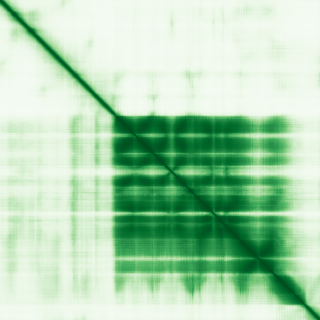
Mean pLDDT
67.8/ 100
Low
731 residues
Confidence breakdown
- Very high(≥ 90)35%
- Confident(70–90)23%
- Low(50–70)1%
- Very low(< 50)41%
Open interactive 3D viewer
AlphaFold (Jumper et al., 2021) · CC BY 4.0
potassium calcium-activated channel subfamily N member 3
Annotations refreshed 3 months ago.
Diagnostic Grade (Green)
DDG2P
MONOALLELIC, autosomal or pseudoautosomal, imprinted status unknownIntellectual disability
MONOALLELIC, autosomal or pseudoautosomal, NOT imprintedLimb disorders
MONOALLELIC, autosomal or pseudoautosomal, NOT imprintedFetal anomalies
MONOALLELIC, autosomal or pseudoautosomal, NOT imprintedDuctal plate malformation
MONOALLELIC, autosomal or pseudoautosomal, imprinted status unknownZimmermann-Laband syndrome 3
Zimmermann-Laband syndrome
atrial fibrillation
hereditary disease
atrial flutter
cardiac arrhythmia
heart disorder
alcohol drinking
chronic obstructive pulmonary disease
prostate carcinoma
Score is the Open Targets composite evidence score (0-1). Higher = stronger gene-disease association.
Small conductance calcium-activated potassium channel protein 3
Small conductance calcium-activated potassium channel that mediates the voltage-independent transmembrane transfer of potassium across the cell membrane through a constitutive interaction with calmodulin which binds the intracellular calcium allowing its opening (PubMed:12808432, PubMed:20562108, PubMed:31155282, PubMed:36502918). The current is characterized by a voltage-independent activation, an intracellular calcium concentration increase-dependent activation and a single-channel conductance of 10 picosiemens (PubMed:12808432, PubMed:20562108, PubMed:31155282, PubMed:36502918). Also presents an inwardly rectifying current, thus reducing its already small outward conductance of potassium ions, which is particularly the case when the membrane potential displays positive values, above + 20 mV (PubMed:12808432). Activation is followed by membrane hyperpolarization. Thought to regulate neuronal excitability by contributing to the slow component of synaptic afterhyperpolarization (By similarity)
KCNN3 · Q9UGI6
Mean pLDDT
67.8/ 100
Low
731 residues
Confidence breakdown
AlphaFold (Jumper et al., 2021) · CC BY 4.0