
AlphaFold predicted structure
KCNN4 · O15554
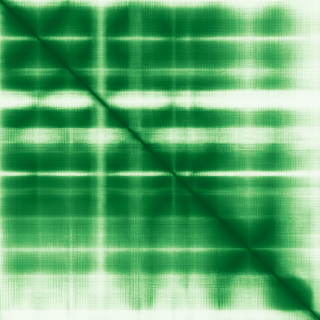
Mean pLDDT
84.2/ 100
Confident
427 residues
Confidence breakdown
- Very high(≥ 90)51%
- Confident(70–90)36%
- Low(50–70)7%
- Very low(< 50)7%
Open interactive 3D viewer
AlphaFold (Jumper et al., 2021) · CC BY 4.0
potassium calcium-activated channel subfamily N member 4
Annotations refreshed 2 months ago.
Diagnostic Grade (Green)
Rare anaemia
MONOALLELIC, autosomal or pseudoautosomal, imprinted status unknownFetal anomalies
MONOALLELIC, autosomal or pseudoautosomal, NOT imprinteddehydrated hereditary stomatocytosis
hereditary disease
cystic fibrosis
breast carcinoma
dehydrated hereditary stomatocytosis with or without pseudohyperkalemia and/or perinatal edema
breast cancer
luminal A breast carcinoma
sickle cell disease
reading
Alzheimer disease
Score is the Open Targets composite evidence score (0-1). Higher = stronger gene-disease association.
Intermediate conductance calcium-activated potassium channel protein 4
Intermediate conductance calcium-activated potassium channel that mediates the voltage-independent transmembrane transfer of potassium across the cell membrane through a constitutive interaction with calmodulin which binds the intracellular calcium allowing its opening (PubMed:10026195, PubMed:10961988, PubMed:11425865, PubMed:15831468, PubMed:17157250, PubMed:18796614, PubMed:26148990, PubMed:9326665, PubMed:9380751, PubMed:9407042). The current is characterized by a voltage-independent activation, an intracellular calcium concentration increase-dependent activation and a single-channel conductance of about 25 picosiemens (PubMed:9326665, PubMed:9380751, PubMed:9407042). Also presents an inwardly rectifying current, thus reducing its already small outward conductance of potassium ions, which is particularly the case when the membrane potential displays positive values, above + 20 mV (PubMed:9326665, PubMed:9380751, PubMed:9407042). Controls calcium influx during vascular contractility by being responsible of membrane hyperpolarization induced by vasoactive factors in proliferative vascular smooth muscle cell types (By similarity). Following calcium influx, the consecutive activation of KCNN4 channel leads to a hyperpolarization of the cell membrane potential and hence an increase of the electrical driving force for further calcium influx promoting sustained calcium entry in response to stimulation with chemotactic peptides (PubMed:26418693). Required for maximal calcium influx and proliferation during the reactivation of naive T-cells (PubMed:17157250, PubMed:18796614). Plays a role in the late stages of EGF-induced macropinocytosis through activation by PI(3)P (PubMed:24591580)
KCNN4 · O15554
Mean pLDDT
84.2/ 100
Confident
427 residues
Confidence breakdown
AlphaFold (Jumper et al., 2021) · CC BY 4.0