
AlphaFold predicted structure
KCNQ2 · O43526
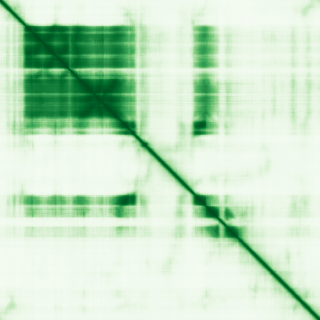
Mean pLDDT
58.2/ 100
Low
872 residues
Confidence breakdown
- Very high(≥ 90)21%
- Confident(70–90)19%
- Low(50–70)6%
- Very low(< 50)53%
Open interactive 3D viewer
AlphaFold (Jumper et al., 2021) · CC BY 4.0
potassium voltage-gated channel subfamily Q member 2
Annotations refreshed 2 months ago.
Diagnostic Grade (Green)
Brain channelopathy
MONOALLELIC, autosomal or pseudoautosomal, NOT imprintedChildhood onset dystonia, chorea or related movement disorder
MONOALLELIC, autosomal or pseudoautosomal, NOT imprintedDDG2P
MONOALLELIC, autosomal or pseudoautosomal, imprinted status unknownEarly onset or syndromic epilepsy
MONOALLELIC, autosomal or pseudoautosomal, NOT imprintedHereditary ataxia with onset in adulthood
MONOALLELIC, autosomal or pseudoautosomal, NOT imprintedIntellectual disability
MONOALLELIC, autosomal or pseudoautosomal, NOT imprintedParoxysmal central nervous system disorders
MONOALLELIC, autosomal or pseudoautosomal, imprinted status unknownAdult onset dystonia, chorea or related movement disorder
MONOALLELIC, autosomal or pseudoautosomal, NOT imprinted+4 more panels — install the extension to see the full list inline on any page.
Benign familial neonatal seizures
seizures, benign familial neonatal, 1
genetic developmental and epileptic encephalopathy
Seizure
Epileptic encephalopathy
epilepsy
developmental and epileptic encephalopathy
multiple sclerosis
early-infantile DEE
Lambert-Eaton myasthenic syndrome
Score is the Open Targets composite evidence score (0-1). Higher = stronger gene-disease association.
Potassium voltage-gated channel subfamily KQT member 2
Pore-forming subunit of the voltage-gated potassium (Kv) M-channel which is responsible for the M-current, a key controller of neuronal excitability (PubMed:24277843, PubMed:28793216, PubMed:9836639). M-channel is composed of pore-forming subunits KCNQ2 and KCNQ3 assembled as heterotetramers (PubMed:10781098, PubMed:14534157, PubMed:32884139, PubMed:37857637, PubMed:9836639). The native M-current has a slowly activating and deactivating potassium conductance which plays a critical role in determining the subthreshold electrical excitability of neurons as well as the responsiveness to synaptic inputs (PubMed:14534157, PubMed:28793216, PubMed:9836639). KCNQ2-KCNQ3 M-channel is selectively permeable in vitro to other cations besides potassium, in decreasing order of affinity K(+) > Rb(+) > Cs(+) > Na(+) (PubMed:28793216). M-channel association with SLC5A3/SMIT1 alters channel ion selectivity, increasing Na(+) and Cs(+) permeation relative to K(+) (PubMed:28793216). Suppressed by activation of the muscarinic acetylcholine receptor CHRM1 (PubMed:10684873, PubMed:10713961)
Curated MONDO disease pages that list KCNQ2 among their top associated genes.
KCNQ2 · O43526
Mean pLDDT
58.2/ 100
Low
872 residues
Confidence breakdown
AlphaFold (Jumper et al., 2021) · CC BY 4.0