
AlphaFold predicted structure
KIT · P10721
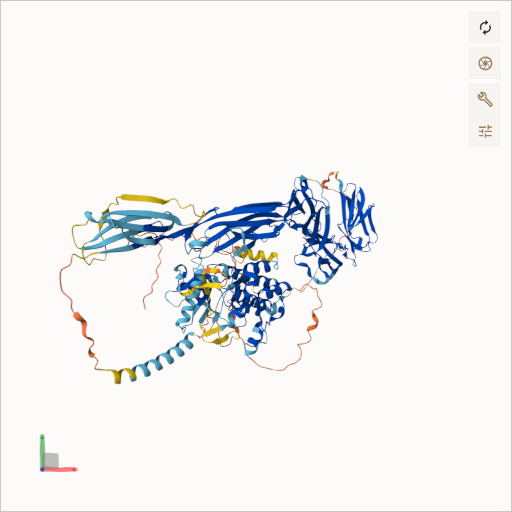
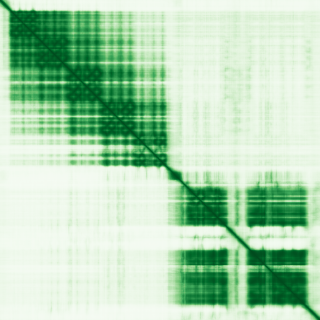
Mean pLDDT
78.2/ 100
Confident
976 residues
Confidence breakdown
- Very high(≥ 90)50%
- Confident(70–90)24%
- Low(50–70)10%
- Very low(< 50)16%
Open interactive 3D viewer
AlphaFold (Jumper et al., 2021) · CC BY 4.0
KIT proto-oncogene, receptor tyrosine kinase
Annotations refreshed 3 months ago.
Diagnostic Grade (Green)
Adult solid tumours cancer susceptibility
MONOALLELIC, autosomal or pseudoautosomal, imprinted status unknownAdult solid tumours for rare disease
MONOALLELIC, autosomal or pseudoautosomal, imprinted status unknownDDG2P
MONOALLELIC, autosomal or pseudoautosomal, imprinted status unknownInherited predisposition to GIST
MONOALLELIC, autosomal or pseudoautosomal, imprinted status unknownMonogenic hearing loss
BOTH monoallelic and biallelic (but BIALLELIC mutations cause a more SEVERE disease form), autosomal or pseudoautosomalPigmentary skin disorders
BOTH monoallelic and biallelic (but BIALLELIC mutations cause a more SEVERE disease form), autosomal or pseudoautosomalRare genetic inflammatory skin disorders
MONOALLELIC, autosomal or pseudoautosomal, NOT imprintedSarcoma cancer susceptibility
MONOALLELIC, autosomal or pseudoautosomal, imprinted status unknown+7 more panels — install the extension to see the full list inline on any page.
gastrointestinal stromal tumor
piebaldism
cutaneous mastocytosis
acute myeloid leukemia
chronic myelogenous leukemia, BCR-ABL1 positive
hepatocellular carcinoma
mastocytosis
cancer
systemic mastocytosis
neoplasm
Score is the Open Targets composite evidence score (0-1). Higher = stronger gene-disease association.
Mast/stem cell growth factor receptor Kit
Tyrosine-protein kinase that acts as a cell-surface receptor for the cytokine KITLG/SCF and plays an essential role in the regulation of cell survival and proliferation, hematopoiesis, stem cell maintenance, gametogenesis, mast cell development, migration and function, and in melanogenesis. In response to KITLG/SCF binding, KIT can activate several signaling pathways. Phosphorylates PIK3R1, PLCG1, SH2B2/APS and CBL. Activates the AKT1 signaling pathway by phosphorylation of PIK3R1, the regulatory subunit of phosphatidylinositol 3-kinase. Activated KIT also transmits signals via GRB2 and activation of RAS, RAF1 and the MAP kinases MAPK1/ERK2 and/or MAPK3/ERK1. Promotes activation of STAT family members STAT1, STAT3, STAT5A and STAT5B. Activation of PLCG1 leads to the production of the cellular signaling molecules diacylglycerol and inositol 1,4,5-trisphosphate. KIT signaling is modulated by protein phosphatases, and by rapid internalization and degradation of the receptor. Activated KIT promotes phosphorylation of the protein phosphatases PTPN6/SHP-1 and PTPRU, and of the transcription factors STAT1, STAT3, STAT5A and STAT5B. Promotes phosphorylation of PIK3R1, CBL, CRK (isoform Crk-II), LYN, MAPK1/ERK2 and/or MAPK3/ERK1, PLCG1, SRC and SHC1
Curated MONDO disease pages that list KIT among their top associated genes.
KIT · P10721
Mean pLDDT
78.2/ 100
Confident
976 residues
Confidence breakdown
AlphaFold (Jumper et al., 2021) · CC BY 4.0