
AlphaFold predicted structure
LMNA · P02545
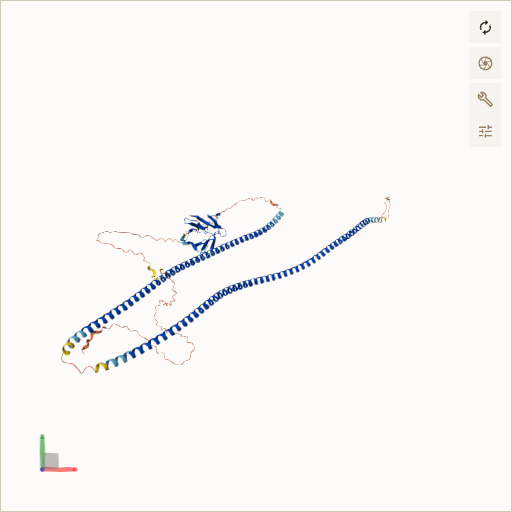
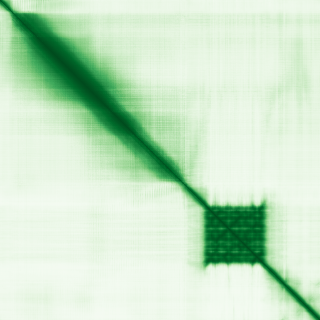
Mean pLDDT
76.4/ 100
Confident
664 residues
Confidence breakdown
- Very high(≥ 90)58%
- Confident(70–90)11%
- Low(50–70)5%
- Very low(< 50)26%
Open interactive 3D viewer
AlphaFold (Jumper et al., 2021) · CC BY 4.0
lamin A/C
Annotations refreshed 2 months ago.
Diagnostic Grade (Green)
Arrhythmogenic right ventricular cardiomyopathy
MONOALLELIC, autosomal or pseudoautosomal, NOT imprintedCongenital muscular dystrophy
BOTH monoallelic and biallelic, autosomal or pseudoautosomalCongenital myopathy
BOTH monoallelic and biallelic, autosomal or pseudoautosomalDDG2P
MONOALLELIC, autosomal or pseudoautosomal, imprinted status unknownDiabetes with additional phenotypes suggestive of a monogenic aetiology
MONOALLELIC, autosomal or pseudoautosomal, NOT imprintedDilated and arrhythmogenic cardiomyopathy
MONOALLELIC, autosomal or pseudoautosomal, imprinted status unknownDilated Cardiomyopathy and conduction defects
MONOALLELIC, autosomal or pseudoautosomal, imprinted status unknownFamilial diabetes
MONOALLELIC, autosomal or pseudoautosomal, NOT imprinted+20 more panels — install the extension to see the full list inline on any page.
dilated cardiomyopathy
Emery-Dreifuss muscular dystrophy 2, autosomal dominant
familial partial lipodystrophy, Dunnigan type
Hutchinson-Gilford progeria syndrome
congenital muscular dystrophy due to LMNA mutation
mandibuloacral dysplasia with type A lipodystrophy
Emery-Dreifuss muscular dystrophy
Charcot-Marie-Tooth disease type 2B1
dilated cardiomyopathy 1A
dilated cardiomyopathy-hypergonadotropic hypogonadism syndrome
Score is the Open Targets composite evidence score (0-1). Higher = stronger gene-disease association.
Prelamin-A/C
Lamins are intermediate filament proteins that assemble into a filamentous meshwork, and which constitute the major components of the nuclear lamina, a fibrous layer on the nucleoplasmic side of the inner nuclear membrane (PubMed:10080180, PubMed:10580070, PubMed:10587585, PubMed:10814726, PubMed:11799477, PubMed:12075506, PubMed:12927431, PubMed:15317753, PubMed:18551513, PubMed:18611980, PubMed:2188730, PubMed:22431096, PubMed:2344612, PubMed:23666920, PubMed:24741066, PubMed:31434876, PubMed:31548606, PubMed:37788673, PubMed:37832547). Lamins provide a framework for the nuclear envelope, bridging the nuclear envelope and chromatin, thereby playing an important role in nuclear assembly, chromatin organization, nuclear membrane and telomere dynamics (PubMed:10080180, PubMed:10580070, PubMed:10587585, PubMed:10814726, PubMed:11799477, PubMed:12075506, PubMed:12927431, PubMed:15317753, PubMed:18551513, PubMed:18611980, PubMed:22431096, PubMed:23666920, PubMed:24741066, PubMed:31548606, PubMed:37788673, PubMed:37832547). Lamin A and C also regulate matrix stiffness by conferring nuclear mechanical properties (PubMed:23990565, PubMed:25127216). The structural integrity of the lamina is strictly controlled by the cell cycle, as seen by the disintegration and formation of the nuclear envelope in prophase and telophase, respectively (PubMed:2188730, PubMed:2344612). Lamin A and C are present in equal amounts in the lamina of mammals (PubMed:10080180, PubMed:10580070, PubMed:10587585, PubMed:10814726, PubMed:11799477, PubMed:12075506, PubMed:12927431, PubMed:15317753, PubMed:18551513, PubMed:18611980, PubMed:22431096, PubMed:23666920, PubMed:31548606). Also involved in DNA repair: recruited by DNA repair proteins XRCC4 and IFFO1 to the DNA double-strand breaks (DSBs) to prevent chromosome translocation by immobilizing broken DNA ends (PubMed:31548606). Required for normal development of peripheral nervous system and skeletal muscle and for muscle satellite cell proliferation (PubMed:10080180, PubMed:10814726, PubMed:11799477, PubMed:18551513, PubMed:22431096). Required for osteoblastogenesis and bone formation (PubMed:12075506, PubMed:15317753, PubMed:18611980). Also prevents fat infiltration of muscle and bone marrow, helping to maintain the volume and strength of skeletal muscle and bone (PubMed:10587585). Required for cardiac homeostasis (PubMed:10580070, PubMed:12927431, PubMed:18611980, PubMed:23666920)
Curated MONDO disease pages that list LMNA among their top associated genes.
LMNA · P02545
Mean pLDDT
76.4/ 100
Confident
664 residues
Confidence breakdown
AlphaFold (Jumper et al., 2021) · CC BY 4.0