
AlphaFold predicted structure
MAPK8IP3 · Q9UPT6
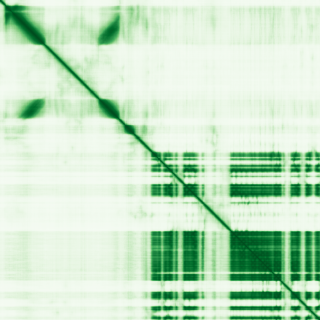
Mean pLDDT
62.0/ 100
Low
1,336 residues
Confidence breakdown
- Very high(≥ 90)23%
- Confident(70–90)24%
- Low(50–70)7%
- Very low(< 50)46%
Open interactive 3D viewer
AlphaFold (Jumper et al., 2021) · CC BY 4.0
mitogen-activated protein kinase 8 interacting protein 3
Annotations refreshed 3 months ago.
Diagnostic Grade (Green)
Ataxia and cerebellar anomalies - narrow panel
MONOALLELIC, autosomal or pseudoautosomal, NOT imprintedChildhood onset hereditary spastic paraplegia
MONOALLELIC, autosomal or pseudoautosomal, NOT imprintedDDG2P
MONOALLELIC, autosomal or pseudoautosomal, imprinted status unknownFetal anomalies
MONOALLELIC, autosomal or pseudoautosomal, NOT imprintedIntellectual disability
MONOALLELIC, autosomal or pseudoautosomal, imprinted status unknownMalformations of cortical development
MONOALLELIC, autosomal or pseudoautosomal, NOT imprintedHereditary neuropathy or pain disorder
MONOALLELIC, autosomal or pseudoautosomal, imprinted status unknownHereditary ataxia with onset in adulthood
MONOALLELIC, autosomal or pseudoautosomal, NOT imprintedneurodevelopmental disorder with or without variable brain abnormalities; NEDBA
hereditary disease
neurodevelopmental disorder
Cerebral atrophy
polymicrogyria
complex neurodevelopmental disorder
neurodegenerative disease
Intellectual disability
developmental disability
Global developmental delay
Score is the Open Targets composite evidence score (0-1). Higher = stronger gene-disease association.
C-Jun-amino-terminal kinase-interacting protein 3
The JNK-interacting protein (JIP) group of scaffold proteins selectively mediates JNK signaling by aggregating specific components of the MAPK cascade to form a functional JNK signaling module (PubMed:12189133). May function as a regulator of vesicle transport, through interactions with the JNK-signaling components and motor proteins (By similarity). Promotes neuronal axon elongation in a kinesin- and JNK-dependent manner. Activates cofilin at axon tips via local activation of JNK, thereby regulating filopodial dynamics and enhancing axon elongation. Its binding to kinesin heavy chains (KHC), promotes kinesin-1 motility along microtubules and is essential for axon elongation and regeneration. Regulates cortical neuronal migration by mediating NTRK2/TRKB anterograde axonal transport during brain development (By similarity). Acts as an adapter that bridges the interaction between NTRK2/TRKB and KLC1 and drives NTRK2/TRKB axonal but not dendritic anterograde transport, which is essential for subsequent BDNF-triggered signaling and filopodia formation (PubMed:21775604)
MAPK8IP3 · Q9UPT6
Mean pLDDT
62.0/ 100
Low
1,336 residues
Confidence breakdown
AlphaFold (Jumper et al., 2021) · CC BY 4.0