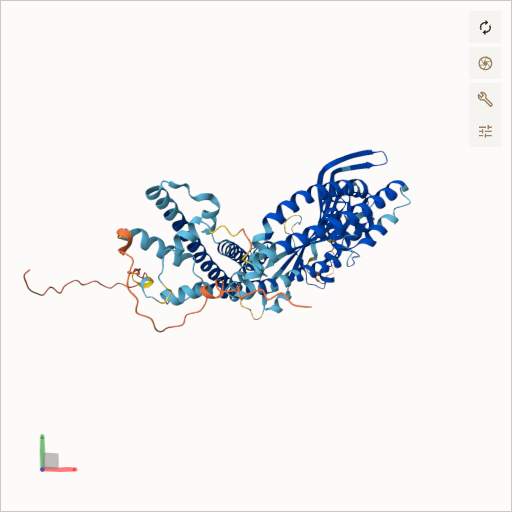
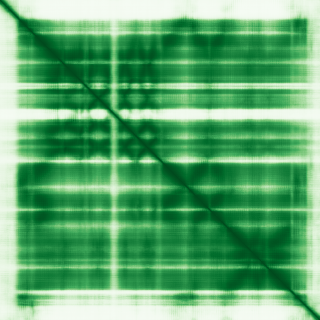
+10 more panels — install the extension to see the full list inline on any page.
Disease associations (Open Targets)
mucolipidosis type IV
0.84
Lisch epithelial corneal dystrophy
0.73
hereditary disease
0.52
neurodegenerative disease
0.39
mucolipidosis
0.34
Intellectual disability
0.32
Corneal opacity
0.32
Delayed myelination
0.32
Atrophy/Degeneration affecting the brainstem
0.32
Delayed speech and language development
0.32
Score is the Open Targets composite evidence score (0-1). Higher = stronger gene-disease association.
Protein function (UniProt)
Mucolipin-1
Nonselective cation channel probably playing a role in the regulation of membrane trafficking events and of metal homeostasis (PubMed:11013137, PubMed:12459486, PubMed:14749347, PubMed:15336987, PubMed:18794901, PubMed:25720963, PubMed:27623384, PubMed:29019983). Acts as a Ca(2+)-permeable cation channel with inwardly rectifying activity (PubMed:25720963, PubMed:29019983). Proposed to play a major role in Ca(2+) release from late endosome and lysosome vesicles to the cytoplasm, which is important for many lysosome-dependent cellular events, including the fusion and trafficking of these organelles, exocytosis and autophagy (PubMed:11013137, PubMed:12459486, PubMed:14749347, PubMed:15336987, PubMed:25720963, PubMed:27623384, PubMed:29019983). Required for efficient uptake of large particles in macrophages in which Ca(2+) release from the lysosomes triggers lysosomal exocytosis. May also play a role in phagosome-lysosome fusion (By similarity). Involved in lactosylceramide trafficking indicative for a role in the regulation of late endocytic membrane fusion/fission events (PubMed:16978393). By mediating lysosomal Ca(2+) release is involved in regulation of mTORC1 signaling and in mTOR/TFEB-dependent lysosomal adaptation to environmental cues such as nutrient levels (PubMed:25720963, PubMed:25733853, PubMed:27787197). Seems to act as lysosomal active oxygen species (ROS) sensor involved in ROS-induced TFEB activation and autophagy (PubMed:27357649). Also functions as a Fe(2+) permeable channel in late endosomes and lysosomes (PubMed:18794901). Also permeable to Mg(2+), Na(+), K(+) and Cs(+) (By similarity). Proposed to play a role in zinc homeostasis probably implicating its association with TMEM163 (PubMed:25130899) In adaptive immunity, TRPML2 and TRPML1 may play redundant roles in the function of the specialized lysosomes of B cells (By similarity)