
AlphaFold predicted structure
MKKS · Q9NPJ1
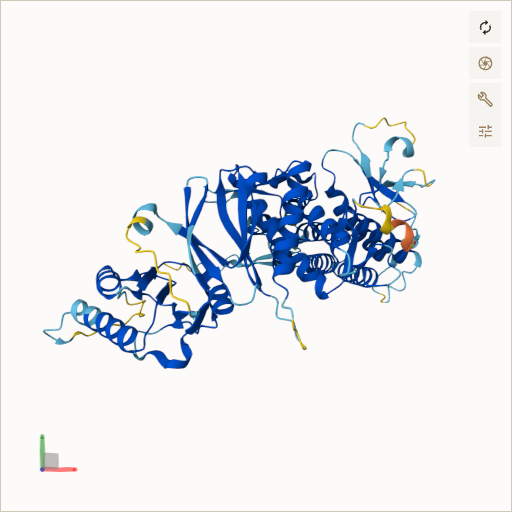
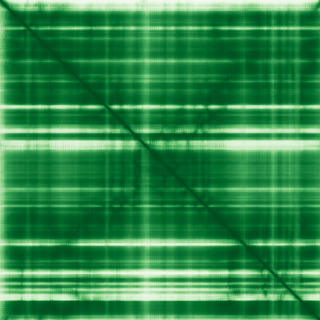
Mean pLDDT
88.9/ 100
Confident
570 residues
Confidence breakdown
- Very high(≥ 90)65%
- Confident(70–90)26%
- Low(50–70)8%
- Very low(< 50)1%
Open interactive 3D viewer
AlphaFold (Jumper et al., 2021) · CC BY 4.0
MKKS centrosomal shuttling protein
Annotations refreshed 2 months ago.
Diagnostic Grade (Green)
Bardet Biedl syndrome
BIALLELIC, autosomal or pseudoautosomalDDG2P
BIALLELIC, autosomal or pseudoautosomalFetal anomalies
BIALLELIC, autosomal or pseudoautosomalIntellectual disability
BIALLELIC, autosomal or pseudoautosomalLimb disorders
BIALLELIC, autosomal or pseudoautosomalOphthalmological ciliopathies
BIALLELIC, autosomal or pseudoautosomalRare multisystem ciliopathy disorders
BIALLELIC, autosomal or pseudoautosomalRenal ciliopathies
BIALLELIC, autosomal or pseudoautosomal+11 more panels — install the extension to see the full list inline on any page.
Bardet-Biedl syndrome
McKusick-Kaufman syndrome
hereditary disease
Bardet-Biedl syndrome 1
Retinal dystrophy
polydactyly
MKKS-related ciliopathy
nephronophthisis
obesity due to melanocortin 4 receptor deficiency
obesity disorder
Score is the Open Targets composite evidence score (0-1). Higher = stronger gene-disease association.
Molecular chaperone MKKS
Probable molecular chaperone that assists the folding of proteins upon ATP hydrolysis (PubMed:20080638). Plays a role in the assembly of BBSome, a complex involved in ciliogenesis regulating transports vesicles to the cilia (PubMed:20080638). May play a role in protein processing in limb, cardiac and reproductive system development. May play a role in cytokinesis (PubMed:28753627)
MKKS · Q9NPJ1
Mean pLDDT
88.9/ 100
Confident
570 residues
Confidence breakdown
AlphaFold (Jumper et al., 2021) · CC BY 4.0