
AlphaFold predicted structure
MSH2 · P43246
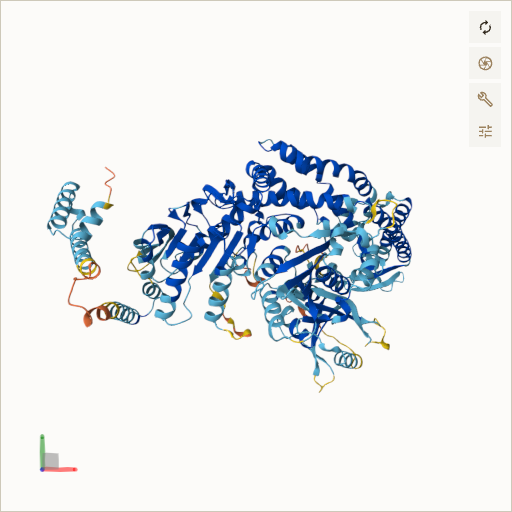
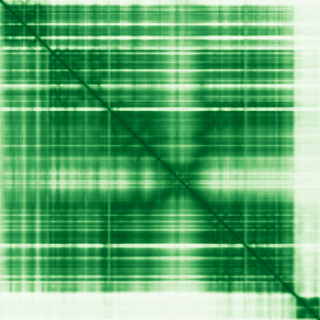
Mean pLDDT
85.3/ 100
Confident
934 residues
Confidence breakdown
- Very high(≥ 90)46%
- Confident(70–90)43%
- Low(50–70)7%
- Very low(< 50)5%
Open interactive 3D viewer
AlphaFold (Jumper et al., 2021) · CC BY 4.0
mutS homolog 2
Annotations refreshed 2 months ago.
Diagnostic Grade (Green)
Additional findings health related
MONOALLELIC, autosomal or pseudoautosomal, imprinted status unknownAdditional findings health related - adult specific
MONOALLELIC, autosomal or pseudoautosomal, imprinted status unknownAdditional findings health related - CNV analysis adult specific
MONOALLELIC, autosomal or pseudoautosomal, imprinted status unknownAdult solid tumours cancer susceptibility
MONOALLELIC, autosomal or pseudoautosomal, imprinted status unknownAdult solid tumours for rare disease
MONOALLELIC, autosomal or pseudoautosomal, imprinted status unknownBladder cancer pertinent cancer susceptibility
MONOALLELIC, autosomal or pseudoautosomal, NOT imprintedBrain cancer pertinent cancer susceptibility
MONOALLELIC, autosomal or pseudoautosomal, NOT imprintedChildhood solid tumours
BIALLELIC, autosomal or pseudoautosomal+29 more panels — install the extension to see the full list inline on any page.
Lynch syndrome
Constitutional mismatch repair deficiency syndrome
Muir-Torre syndrome
mismatch repair cancer syndrome 1
colon carcinoma
hereditary nonpolyposis colon cancer
malignant colon neoplasm
colorectal cancer
endometrial carcinoma
uterine corpus cancer
Score is the Open Targets composite evidence score (0-1). Higher = stronger gene-disease association.
DNA mismatch repair protein Msh2
Component of the post-replicative DNA mismatch repair system (MMR). Forms two different heterodimers: MutS alpha (MSH2-MSH6 heterodimer) and MutS beta (MSH2-MSH3 heterodimer) which binds to DNA mismatches thereby initiating DNA repair. When bound, heterodimers bend the DNA helix and shields approximately 20 base pairs. MutS alpha recognizes single base mismatches and dinucleotide insertion-deletion loops (IDL) in the DNA. MutS beta recognizes larger insertion-deletion loops up to 13 nucleotides long. After mismatch binding, MutS alpha or beta forms a ternary complex with the MutL alpha heterodimer, which is thought to be responsible for directing the downstream MMR events, including strand discrimination, excision, and resynthesis. Recruits DNA helicase MCM9 to chromatin which unwinds the mismatch containing DNA strand (PubMed:26300262). ATP binding and hydrolysis play a pivotal role in mismatch repair functions. The ATPase activity associated with MutS alpha regulates binding similar to a molecular switch: mismatched DNA provokes ADP-->ATP exchange, resulting in a discernible conformational transition that converts MutS alpha into a sliding clamp capable of hydrolysis-independent diffusion along the DNA backbone. This transition is crucial for mismatch repair. MutS alpha may also play a role in DNA homologous recombination repair. In melanocytes may modulate both UV-B-induced cell cycle regulation and apoptosis
Curated MONDO disease pages that list MSH2 among their top associated genes.
MSH2 · P43246
Mean pLDDT
85.3/ 100
Confident
934 residues
Confidence breakdown
AlphaFold (Jumper et al., 2021) · CC BY 4.0