Skip to content
GenoLensGenoLens

MT-ATP6

Chr mitochondria

mitochondrially encoded ATP synthase membrane subunit 6

Aliases:
ATP6, ATPase-6, Su6m

Annotations refreshed 8 hours ago.

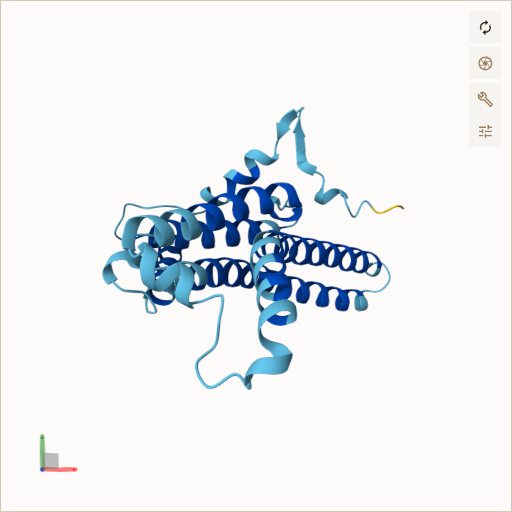
Predicted protein structure

Clinical relevance (Genomics England PanelApp)

Diagnostic Grade (Green)

  • Ataxia and cerebellar anomalies - narrow panel

    MITOCHONDRIAL
  • Hereditary ataxia

    MITOCHONDRIAL
  • Hereditary ataxia with onset in adulthood

    MITOCHONDRIAL
  • Hereditary neuropathy

    MITOCHONDRIAL
  • Hereditary neuropathy or pain disorder

    MITOCHONDRIAL
  • Likely inborn error of metabolism

    MITOCHONDRIAL
  • Mitochondrial disorders

    MITOCHONDRIAL
  • NARP syndrome or maternally inherited Leigh syndrome

    MITOCHONDRIAL

+13 more panels — install the extension to see the full list inline on any page.

Disease associations (Open Targets)

  • NARP syndrome

    0.75
  • Leber hereditary optic neuropathy

    0.72
  • Leigh syndrome

    0.69
  • mitochondrial disease

    0.67
  • mitochondrial complex 5 (ATP synthase) deficiency, mitochondrial type 1

    0.60
  • MELAS syndrome

    0.57
  • MERRF

    0.53
  • MERRF syndrome

    0.52
  • Isolated cytochrome C oxidase deficiency

    0.52
  • leigh syndrome due to mitochondrial complex iv deficiency

    0.52

Score is the Open Targets composite evidence score (0-1). Higher = stronger gene-disease association.

Protein function (UniProt)

ATP synthase F(0) complex subunit a

Subunit a, of the mitochondrial membrane ATP synthase complex (F(1)F(0) ATP synthase or Complex V) that produces ATP from ADP in the presence of a proton gradient across the membrane which is generated by electron transport complexes of the respiratory chain (Probable). ATP synthase complex consist of a soluble F(1) head domain - the catalytic core - and a membrane F(1) domain - the membrane proton channel (PubMed:37244256). These two domains are linked by a central stalk rotating inside the F(1) region and a stationary peripheral stalk (PubMed:37244256). During catalysis, ATP synthesis in the catalytic domain of F(1) is coupled via a rotary mechanism of the central stalk subunits to proton translocation (Probable). With the subunit c (ATP5MC1), forms the proton-conducting channel in the F(0) domain, that contains two crucial half-channels (inlet and outlet) that facilitate proton movement from the mitochondrial intermembrane space (IMS) into the matrix (PubMed:37244256). Protons are taken up via the inlet half-channel and released through the outlet half-channel, following a Grotthuss mechanism (PubMed:37244256)

Curated MONDO disease pages that list MT-ATP6 among their top associated genes.

Data sources: HGNC (CC BY 4.0), AlphaFold (CC BY 4.0, Jumper et al. Nature 2021), Genomics England PanelApp (CC BY 4.0), ClinGen, Open Targets (CC0), UniProt.

Not for sole clinical decision-making. Always verify against primary sources.