
AlphaFold predicted structure
MTPAP · Q9NVV4
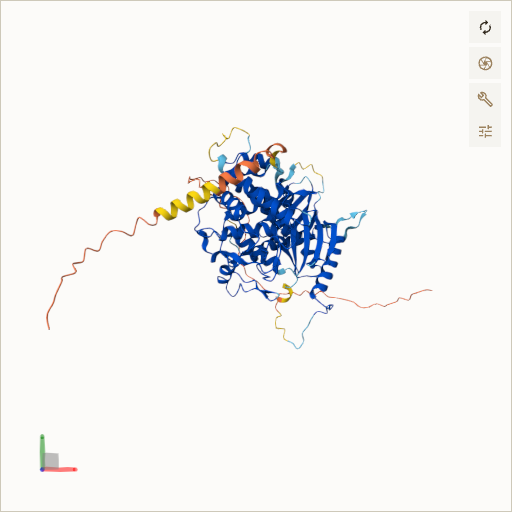
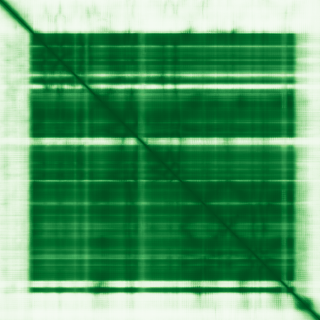
Mean pLDDT
82.8/ 100
Confident
582 residues
Confidence breakdown
- Very high(≥ 90)68%
- Confident(70–90)9%
- Low(50–70)7%
- Very low(< 50)16%
Open interactive 3D viewer
AlphaFold (Jumper et al., 2021) · CC BY 4.0
mitochondrial poly(A) polymerase
Annotations refreshed 2 months ago.
Diagnostic Grade (Green)
Likely inborn error of metabolism
BIALLELIC, autosomal or pseudoautosomalMitochondrial disorders
BIALLELIC, autosomal or pseudoautosomalPossible mitochondrial disorder - nuclear genes
BIALLELIC, autosomal or pseudoautosomalUndiagnosed metabolic disorders
BIALLELIC, autosomal or pseudoautosomalAdult onset hereditary spastic paraplegia
BIALLELIC, autosomal or pseudoautosomalChildhood onset hereditary spastic paraplegia
BIALLELIC, autosomal or pseudoautosomalFetal anomalies
BIALLELIC, autosomal or pseudoautosomalHereditary ataxia with onset in adulthood
BIALLELIC, autosomal or pseudoautosomal+9 more panels — install the extension to see the full list inline on any page.
spastic ataxia 4
Autosomal recessive spastic ataxia - optic atrophy - dysarthria
neurodegenerative disease
mitochondrial disease
inborn mitochondrial metabolism disorder
ovarian dysfunction
spastic ataxia
hereditary disease
lysosomal storage disease
Retinal dystrophy
Score is the Open Targets composite evidence score (0-1). Higher = stronger gene-disease association.
Poly(A) RNA polymerase, mitochondrial
Polymerase that creates the 3' poly(A) tail of mitochondrial transcripts. Can use all four nucleotides, but has higher activity with ATP and UTP (in vitro). Plays a role in replication-dependent histone mRNA degradation. May be involved in the terminal uridylation of mature histone mRNAs before their degradation is initiated. Might be responsible for the creation of some UAA stop codons which are not encoded in mtDNA
MTPAP · Q9NVV4
Mean pLDDT
82.8/ 100
Confident
582 residues
Confidence breakdown
AlphaFold (Jumper et al., 2021) · CC BY 4.0