
AlphaFold predicted structure
P3H2 · Q8IVL5
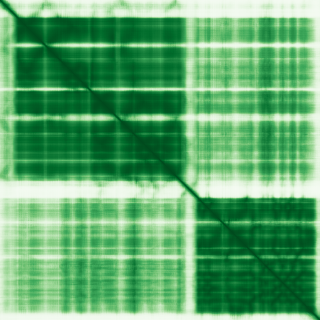
Mean pLDDT
83.4/ 100
Confident
708 residues
Confidence breakdown
- Very high(≥ 90)60%
- Confident(70–90)23%
- Low(50–70)6%
- Very low(< 50)12%
Open interactive 3D viewer
AlphaFold (Jumper et al., 2021) · CC BY 4.0
prolyl 3-hydroxylase 2
Annotations refreshed 2 months ago.
Diagnostic Grade (Green)
Bilateral congenital or childhood onset cataracts
BIALLELIC, autosomal or pseudoautosomalRetinal disorders
BIALLELIC, autosomal or pseudoautosomalStructural eye disease
BIALLELIC, autosomal or pseudoautosomalRare isolated myopia
osteoarthritis, hip
retinitis pigmentosa
bilirubin metabolism disease
osteoarthritis, knee
total joint arthroplasty
Thrombocytopenia
total hip arthroplasty
placental retention
eye disorder
Score is the Open Targets composite evidence score (0-1). Higher = stronger gene-disease association.
Prolyl 3-hydroxylase 2
Prolyl 3-hydroxylase that catalyzes the post-translational formation of 3-hydroxyproline on collagens (PubMed:18487197). Contributes to proline 3-hydroxylation of collagen COL4A1 and COL1A1 in tendons, the eye sclera and in the eye lens capsule (By similarity). Has high activity with the type IV collagen COL4A1, and lower activity with COL1A1 (PubMed:18487197). Catalyzes hydroxylation of the first Pro in Gly-Pro-Hyp sequences where Hyp is 4-hydroxyproline (PubMed:18487197). Has no activity on substrates that lack 4-hydroxyproline in the third position (PubMed:18487197)
P3H2 · Q8IVL5
Mean pLDDT
83.4/ 100
Confident
708 residues
Confidence breakdown
AlphaFold (Jumper et al., 2021) · CC BY 4.0