
AlphaFold predicted structure
PALB2 · Q86YC2
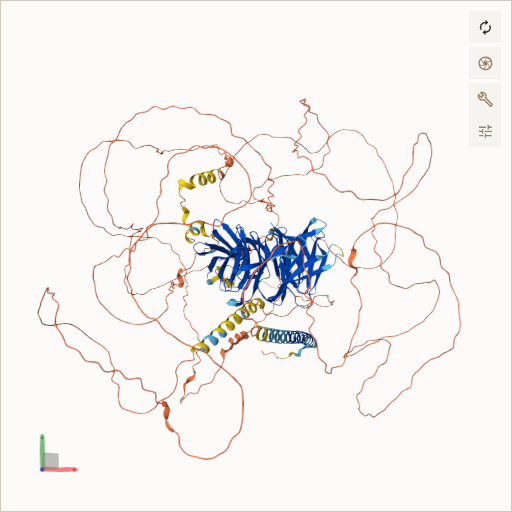

Mean pLDDT
53.8/ 100
Low
1,186 residues
Confidence breakdown
- Very high(≥ 90)23%
- Confident(70–90)9%
- Low(50–70)6%
- Very low(< 50)62%
Open interactive 3D viewer
AlphaFold (Jumper et al., 2021) · CC BY 4.0
partner and localizer of BRCA2
Annotations refreshed 2 months ago.
Diagnostic Grade (Green)
Adult solid tumours cancer susceptibility
MONOALLELIC, autosomal or pseudoautosomal, imprinted status unknownAdult solid tumours for rare disease
MONOALLELIC, autosomal or pseudoautosomal, imprinted status unknownBreast cancer pertinent cancer susceptibility
MONOALLELIC, autosomal or pseudoautosomal, NOT imprintedChildhood solid tumours
BIALLELIC, autosomal or pseudoautosomalChildhood solid tumours cancer susceptibility
BIALLELIC, autosomal or pseudoautosomalConfirmed Fanconi anaemia or Bloom syndrome
BIALLELIC, autosomal or pseudoautosomalCOVID-19 research
BIALLELIC, autosomal or pseudoautosomalCytopenias and congenital anaemias
BIALLELIC, autosomal or pseudoautosomal+18 more panels — install the extension to see the full list inline on any page.
Fanconi anemia complementation group N
breast cancer
breast neoplasm
Fanconi anemia
cancer
Hereditary breast and ovarian cancer syndrome
breast carcinoma
Hereditary breast cancer
familial pancreatic carcinoma
hereditary breast carcinoma
Score is the Open Targets composite evidence score (0-1). Higher = stronger gene-disease association.
Partner and localizer of BRCA2
Plays a critical role in homologous recombination repair (HRR) through its ability to recruit BRCA2 and RAD51 to DNA breaks (PubMed:16793542, PubMed:19369211, PubMed:19423707, PubMed:22941656, PubMed:24141787, PubMed:28319063). Strongly stimulates the DNA strand-invasion activity of RAD51, stabilizes the nucleoprotein filament against a disruptive BRC3-BRC4 polypeptide and helps RAD51 to overcome the suppressive effect of replication protein A (RPA) (PubMed:20871615). Functionally cooperates with RAD51AP1 in promoting of D-loop formation by RAD51 (PubMed:20871616). Serves as the molecular scaffold in the formation of the BRCA1-PALB2-BRCA2 complex which is essential for homologous recombination (PubMed:19369211). Via its WD repeats is proposed to scaffold a HR complex containing RAD51C and BRCA2 which is thought to play a role in HR-mediated DNA repair (PubMed:24141787). Essential partner of BRCA2 that promotes the localization and stability of BRCA2 (PubMed:16793542). Also enables its recombinational repair and checkpoint functions of BRCA2 (PubMed:16793542). May act by promoting stable association of BRCA2 with nuclear structures, allowing BRCA2 to escape the effects of proteasome-mediated degradation (PubMed:16793542). Binds DNA with high affinity for D loop, which comprises single-stranded, double-stranded and branched DNA structures (PubMed:20871616). May play a role in the extension step after strand invasion at replication-dependent DNA double-strand breaks; together with BRCA2 is involved in both POLH localization at collapsed replication forks and DNA polymerization activity (PubMed:24485656)
Curated MONDO disease pages that list PALB2 among their top associated genes.
PALB2 · Q86YC2
Mean pLDDT
53.8/ 100
Low
1,186 residues
Confidence breakdown
AlphaFold (Jumper et al., 2021) · CC BY 4.0