
AlphaFold predicted structure
PMS2 · P54278
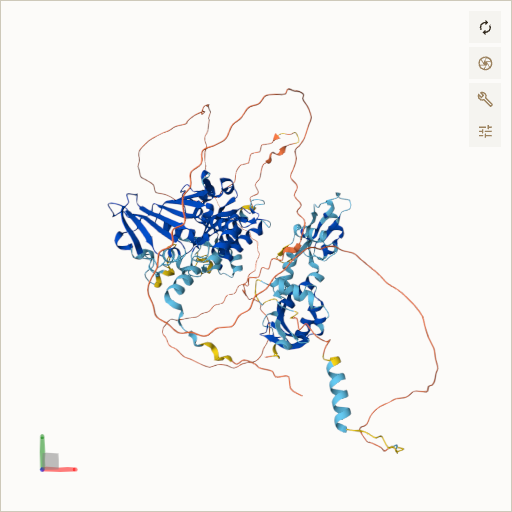
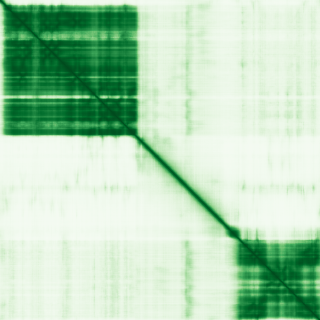
Mean pLDDT
71.0/ 100
Confident
862 residues
Confidence breakdown
- Very high(≥ 90)36%
- Confident(70–90)27%
- Low(50–70)7%
- Very low(< 50)30%
Open interactive 3D viewer
AlphaFold (Jumper et al., 2021) · CC BY 4.0
PMS1 homolog 2, mismatch repair system component
Annotations refreshed 2 months ago.
Diagnostic Grade (Green)
Adult solid tumours cancer susceptibility
MONOALLELIC, autosomal or pseudoautosomal, imprinted status unknownAdult solid tumours for rare disease
MONOALLELIC, autosomal or pseudoautosomal, imprinted status unknownBladder cancer pertinent cancer susceptibility
MONOALLELIC, autosomal or pseudoautosomal, NOT imprintedBrain cancer pertinent cancer susceptibility
MONOALLELIC, autosomal or pseudoautosomal, NOT imprintedChildhood solid tumours
BIALLELIC, autosomal or pseudoautosomalChildhood solid tumours cancer susceptibility
BIALLELIC, autosomal or pseudoautosomalColorectal cancer pertinent cancer susceptibility
MONOALLELIC, autosomal or pseudoautosomal, NOT imprintedCOVID-19 research
BIALLELIC, autosomal or pseudoautosomal+26 more panels — install the extension to see the full list inline on any page.
Lynch syndrome
Constitutional mismatch repair deficiency syndrome
mismatch repair cancer syndrome 1
endometrial carcinoma
Inherited cancer-predisposing syndrome
hereditary neoplastic syndrome
hereditary nonpolyposis colon cancer
Non-polyposis Turcot syndrome
hereditary nonpolyposis colorectal carcinoma
mismatch repair cancer syndrome
Score is the Open Targets composite evidence score (0-1). Higher = stronger gene-disease association.
Mismatch repair endonuclease PMS2
Component of the post-replicative DNA mismatch repair system (MMR) (PubMed:30653781, PubMed:35189042). Heterodimerizes with MLH1 to form MutL alpha. DNA repair is initiated by MutS alpha (MSH2-MSH6) or MutS beta (MSH2-MSH3) binding to a dsDNA mismatch, then MutL alpha is recruited to the heteroduplex. Assembly of the MutL-MutS-heteroduplex ternary complex in presence of RFC and PCNA is sufficient to activate endonuclease activity of PMS2. It introduces single-strand breaks near the mismatch and thus generates new entry points for the exonuclease EXO1 to degrade the strand containing the mismatch. DNA methylation would prevent cleavage and therefore assure that only the newly mutated DNA strand is going to be corrected. MutL alpha (MLH1-PMS2) interacts physically with the clamp loader subunits of DNA polymerase III, suggesting that it may play a role to recruit the DNA polymerase III to the site of the MMR. Also implicated in DNA damage signaling, a process which induces cell cycle arrest and can lead to apoptosis in case of major DNA damages. Possesses an ATPase activity, but in the absence of gross structural changes, ATP hydrolysis may not be necessary for proficient mismatch repair (PubMed:35189042)
Curated MONDO disease pages that list PMS2 among their top associated genes.
PMS2 · P54278
Mean pLDDT
71.0/ 100
Confident
862 residues
Confidence breakdown
AlphaFold (Jumper et al., 2021) · CC BY 4.0