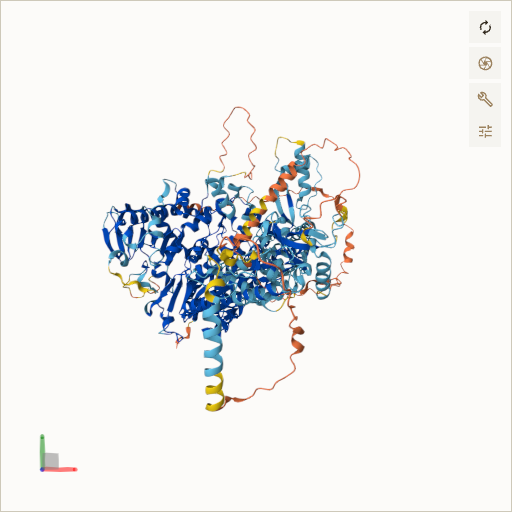
DNA polymerase subunit gamma-1
Catalytic subunit of DNA polymerase gamma solely responsible for replication of mitochondrial DNA (mtDNA). Replicates both heavy and light strands of the circular mtDNA genome using a single-stranded DNA template, RNA primers and the four deoxyribonucleoside triphosphates as substrates (PubMed:11477093, PubMed:11897778, PubMed:15917273, PubMed:19837034, PubMed:9558343). Has 5' -> 3' polymerase activity. Functionally interacts with TWNK and SSBP1 at the replication fork to form a highly processive replisome, where TWNK unwinds the double-stranded DNA template prior to replication and SSBP1 covers the parental heavy strand to enable continuous replication of the entire mitochondrial genome. A single nucleotide incorporation cycle includes binding of the incoming nucleotide at the insertion site, a phosphodiester bond formation reaction that extends the 3'-end of the primer DNA, and translocation of the primer terminus to the post-insertion site. After completing replication of a mtDNA strand, mediates 3' -> 5' exonucleolytic degradation at the nick to enable proper ligation (PubMed:11477093, PubMed:11897778, PubMed:15167897, PubMed:15917273, PubMed:19837034, PubMed:26095671, PubMed:9558343). Highly accurate due to high nucleotide selectivity and 3' -> 5' exonucleolytic proofreading. Proficiently corrects base substitutions, single-base additions and deletions in non-repetitive sequences and short repeats, but displays lower proofreading activity when replicating longer homopolymeric stretches. Exerts exonuclease activity toward single-stranded DNA and double-stranded DNA containing 3'-terminal mispairs. When a misincorporation occurs, transitions from replication to a pro-nucleolytic editing mode and removes the missincorporated nucleoside in the exonuclease active site. Proceeds via an SN2 nucleolytic mechanism in which Asp-198 catalyzes phosphodiester bond hydrolysis and Glu-200 stabilizes the leaving group. As a result the primer strand becomes one nucleotide shorter and is positioned in the post-insertion site, ready to resume DNA synthesis (PubMed:10827171, PubMed:11477094, PubMed:11504725, PubMed:37202477). Exerts 5'-deoxyribose phosphate (dRP) lyase activity and mediates repair-associated mtDNA synthesis (gap filling) in base-excision repair pathway. Catalyzes the release of the 5'-terminal 2-deoxyribose-5-phosphate sugar moiety from incised apurinic/apyrimidinic (AP) sites to produce a substrate for DNA ligase. The dRP lyase reaction does not require divalent metal ions and likely proceeds via a Schiff base intermediate in a beta-elimination reaction mechanism (PubMed:9770471)