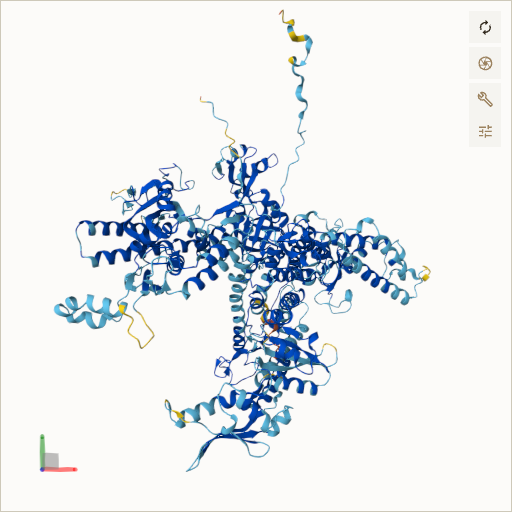
DNA-directed RNA polymerase III subunit RPC1
Catalytic core component of RNA polymerase III (Pol III), a DNA-dependent RNA polymerase which synthesizes small non-coding RNAs using the four ribonucleoside triphosphates as substrates. Synthesizes 5S rRNA, snRNAs, tRNAs and miRNAs from at least 500 distinct genomic loci (PubMed:19609254, PubMed:19631370, PubMed:20413673, PubMed:33335104, PubMed:33558764, PubMed:33558766, PubMed:34675218, PubMed:35637192, PubMed:9331371). Pol III-mediated transcription cycle proceeds through transcription initiation, transcription elongation and transcription termination stages. During transcription initiation, Pol III is recruited to DNA promoters type I, II or III with the help of general transcription factors and other specific initiation factors. Once the polymerase has escaped from the promoter it enters the elongation phase during which RNA is actively polymerized, based on complementarity with the template DNA strand. Transcription termination involves the release of the RNA transcript and polymerase from the DNA (PubMed:20413673, PubMed:33335104, PubMed:33558764, PubMed:33558766, PubMed:33674783, PubMed:34675218). Forms Pol III active center together with the second largest subunit POLR3B/RPC2. Appends one nucleotide at a time to the 3' end of the nascent RNA, with POLR3A/RPC1 contributing a Mg(2+)-coordinating DxDGD motif, and POLR3B/RPC2 participating in the coordination of a second Mg(2+) ion and providing lysine residues believed to facilitate Watson-Crick base pairing between the incoming nucleotide and template base. Typically, Mg(2+) ions direct a 5' nucleoside triphosphate to form a phosphodiester bond with the 3' hydroxyl of the preceding nucleotide of the nascent RNA, with the elimination of pyrophosphate (PubMed:19609254, PubMed:20413673, PubMed:33335104, PubMed:33558764, PubMed:33674783, PubMed:34675218, PubMed:9331371). Pol III plays a key role in sensing and limiting infection by intracellular bacteria and DNA viruses. Acts as a nuclear and cytosolic DNA sensor involved in innate immune response. Can sense non-self dsDNA that serves as template for transcription into dsRNA. The non-self RNA polymerase III transcripts, such as Epstein-Barr virus-encoded RNAs (EBERs) induce type I interferon and NF-kappa-B through the RIG-I pathway