
AlphaFold predicted structure
RAF1 · P04049
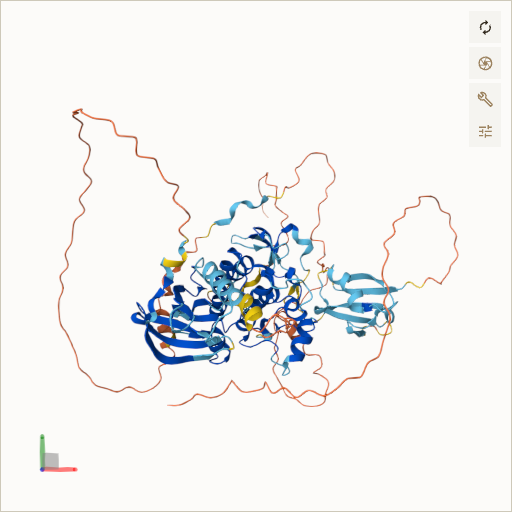
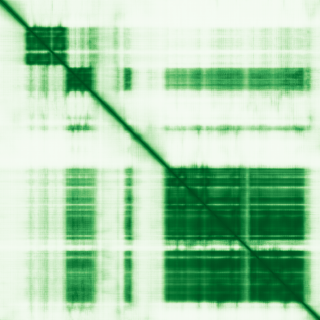
Mean pLDDT
67.5/ 100
Low
648 residues
Confidence breakdown
- Very high(≥ 90)30%
- Confident(70–90)27%
- Low(50–70)8%
- Very low(< 50)36%
Open interactive 3D viewer
AlphaFold (Jumper et al., 2021) · CC BY 4.0
Raf-1 proto-oncogene, serine/threonine kinase
Annotations refreshed 2 months ago.
Diagnostic Grade (Green)
Adult solid tumours cancer susceptibility
MONOALLELIC, autosomal or pseudoautosomal, imprinted status unknownChildhood solid tumours
MONOALLELIC, autosomal or pseudoautosomal, imprinted status unknownChildhood solid tumours cancer susceptibility
MONOALLELIC, autosomal or pseudoautosomal, imprinted status unknownDDG2P
MONOALLELIC, autosomal or pseudoautosomal, imprinted status unknownFetal anomalies
MONOALLELIC, autosomal or pseudoautosomal, imprinted status unknownFetal hydrops
MONOALLELIC, autosomal or pseudoautosomal, NOT imprintedIntellectual disability
MONOALLELIC, autosomal or pseudoautosomal, NOT imprintedIUGR and IGF abnormalities
MONOALLELIC, autosomal or pseudoautosomal, NOT imprinted+11 more panels — install the extension to see the full list inline on any page.
Noonan syndrome
Noonan syndrome with multiple lentigines
Noonan syndrome 5
LEOPARD syndrome 2
dilated cardiomyopathy
RASopathy
hepatocellular carcinoma
cancer
renal cell carcinoma
colorectal cancer
Score is the Open Targets composite evidence score (0-1). Higher = stronger gene-disease association.
RAF proto-oncogene serine/threonine-protein kinase
Serine/threonine-protein kinase that acts as a regulatory link between the membrane-associated Ras GTPases and the MAPK/ERK cascade, and this critical regulatory link functions as a switch determining cell fate decisions including proliferation, differentiation, apoptosis, survival and oncogenic transformation. RAF1 activation initiates a mitogen-activated protein kinase (MAPK) cascade that comprises a sequential phosphorylation of the dual-specific MAPK kinases (MAP2K1/MEK1 and MAP2K2/MEK2) and the extracellular signal-regulated kinases (MAPK3/ERK1 and MAPK1/ERK2). The phosphorylated form of RAF1 (on residues Ser-338 and Ser-339, by PAK1) phosphorylates BAD/Bcl2-antagonist of cell death at 'Ser-75'. Phosphorylates adenylyl cyclases: ADCY2, ADCY5 and ADCY6, resulting in their activation. Phosphorylates PPP1R12A resulting in inhibition of the phosphatase activity. Phosphorylates TNNT2/cardiac muscle troponin T. Can promote NF-kB activation and inhibit signal transducers involved in motility (ROCK2), apoptosis (MAP3K5/ASK1 and STK3/MST2), proliferation and angiogenesis (RB1). Can protect cells from apoptosis also by translocating to the mitochondria where it binds BCL2 and displaces BAD/Bcl2-antagonist of cell death. Regulates Rho signaling and migration, and is required for normal wound healing. Plays a role in the oncogenic transformation of epithelial cells via repression of the TJ protein, occludin (OCLN) by inducing the up-regulation of a transcriptional repressor SNAI2/SLUG, which induces down-regulation of OCLN. Restricts caspase activation in response to selected stimuli, notably Fas stimulation, pathogen-mediated macrophage apoptosis, and erythroid differentiation
Curated MONDO disease pages that list RAF1 among their top associated genes.
RAF1 · P04049
Mean pLDDT
67.5/ 100
Low
648 residues
Confidence breakdown
AlphaFold (Jumper et al., 2021) · CC BY 4.0