
AlphaFold predicted structure
RECQL4 · O94761
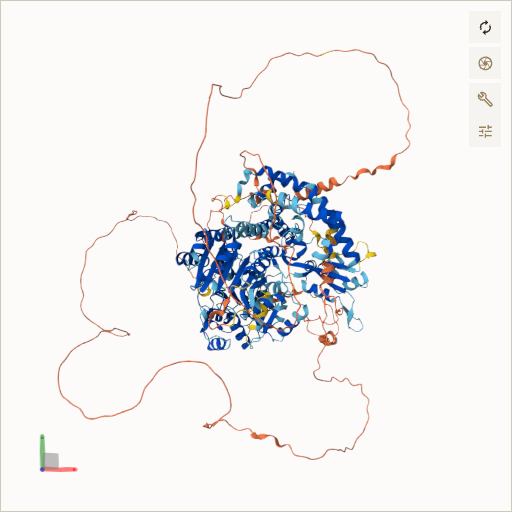
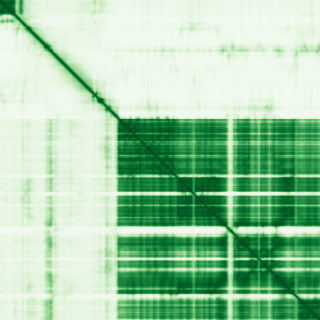
Mean pLDDT
67.4/ 100
Low
1,208 residues
Confidence breakdown
- Very high(≥ 90)32%
- Confident(70–90)27%
- Low(50–70)6%
- Very low(< 50)35%
Open interactive 3D viewer
AlphaFold (Jumper et al., 2021) · CC BY 4.0
RecQ like helicase 4
Annotations refreshed 3 months ago.
Diagnostic Grade (Green)
Childhood solid tumours
BIALLELIC, autosomal or pseudoautosomalChildhood solid tumours cancer susceptibility
BIALLELIC, autosomal or pseudoautosomalCOVID-19 research
BIALLELIC, autosomal or pseudoautosomalCutaneous photosensitivity with a likely genetic cause
BIALLELIC, autosomal or pseudoautosomalDDG2P
BIALLELIC, autosomal or pseudoautosomalFetal anomalies
BIALLELIC, autosomal or pseudoautosomalLimb disorders
BIALLELIC, autosomal or pseudoautosomalMonogenic short stature
BIALLELIC, autosomal or pseudoautosomal+13 more panels — install the extension to see the full list inline on any page.
Rothmund-Thomson syndrome type 2
Baller-Gerold syndrome
rapadilino syndrome
Rothmund-Thomson syndrome
osteosarcoma
Inherited cancer-predisposing syndrome
hereditary neoplastic syndrome
hereditary disease
severe combined immunodeficiency
combined immunodeficiency
Score is the Open Targets composite evidence score (0-1). Higher = stronger gene-disease association.
ATP-dependent DNA helicase Q4
An ATP-dependent DNA helicase which unwinds dsDNA with a 3'-overhang in a 3'-5' direction (PubMed:28653661). Does not unwind more than 18 bp of dsDNA (PubMed:28653661). May modulate chromosome segregation. The N-terminal domain (residues 1-54) binds DNA Y-shaped DNA better than ss- or dsDNA (PubMed:22730300). The core helicase domain binds ssDNA (PubMed:22730300, PubMed:28653661)
Curated MONDO disease pages that list RECQL4 among their top associated genes.
RECQL4 · O94761
Mean pLDDT
67.4/ 100
Low
1,208 residues
Confidence breakdown
AlphaFold (Jumper et al., 2021) · CC BY 4.0